Enjoy Acid
How Joe McDowell is challenging the status quo of the distilled spirits industry
Text by Ebru Eltemur
Photography by Mert Karakaş
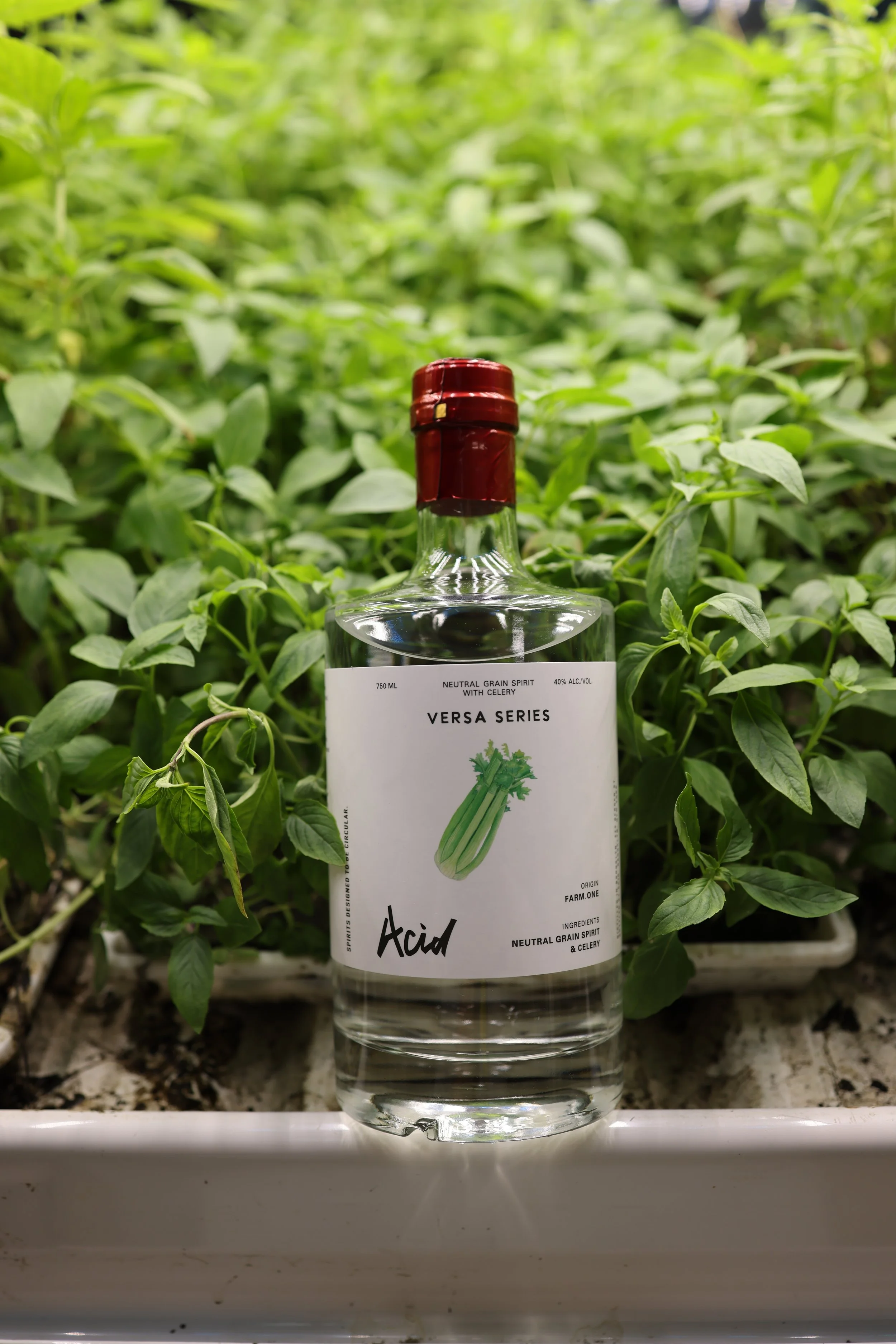
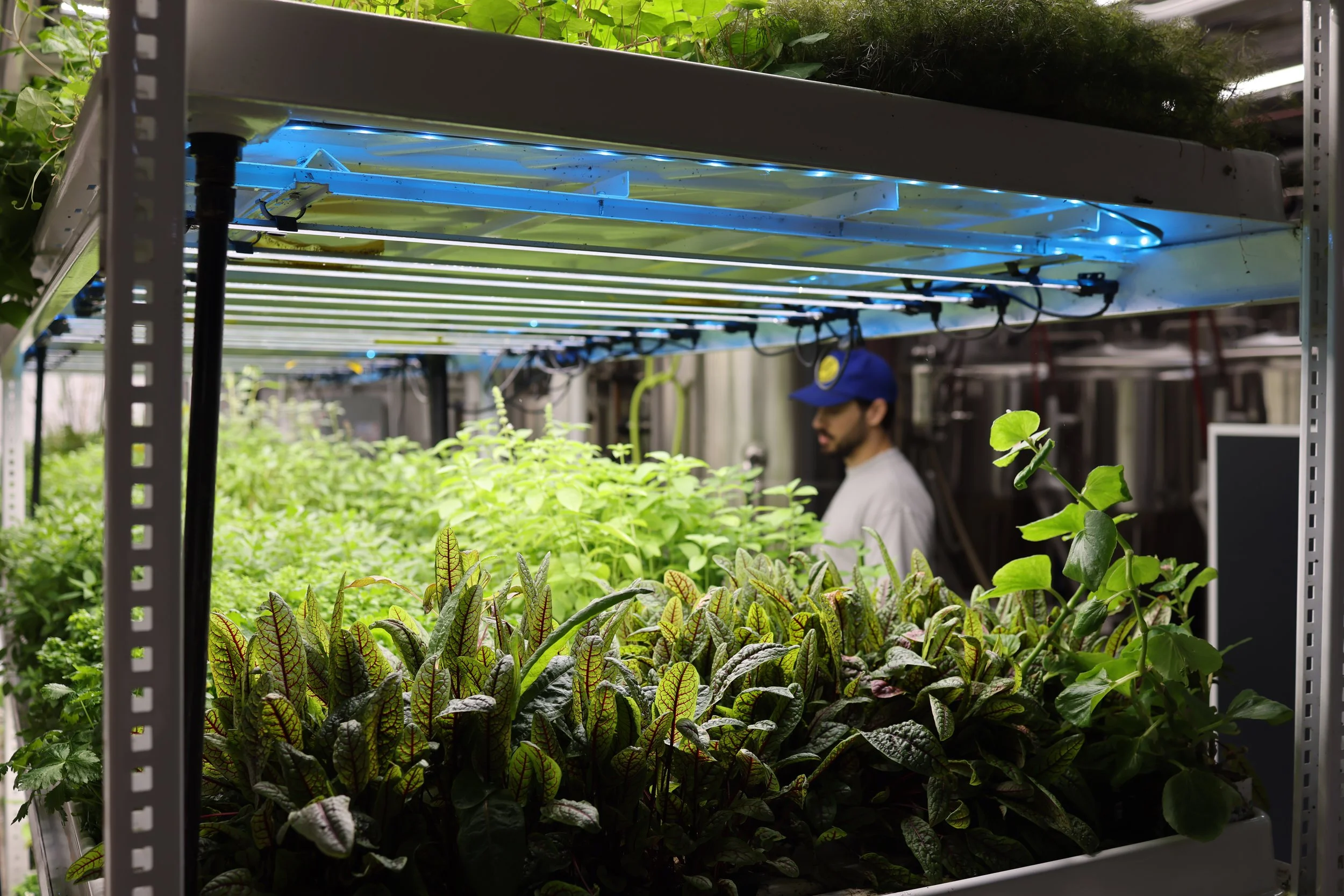
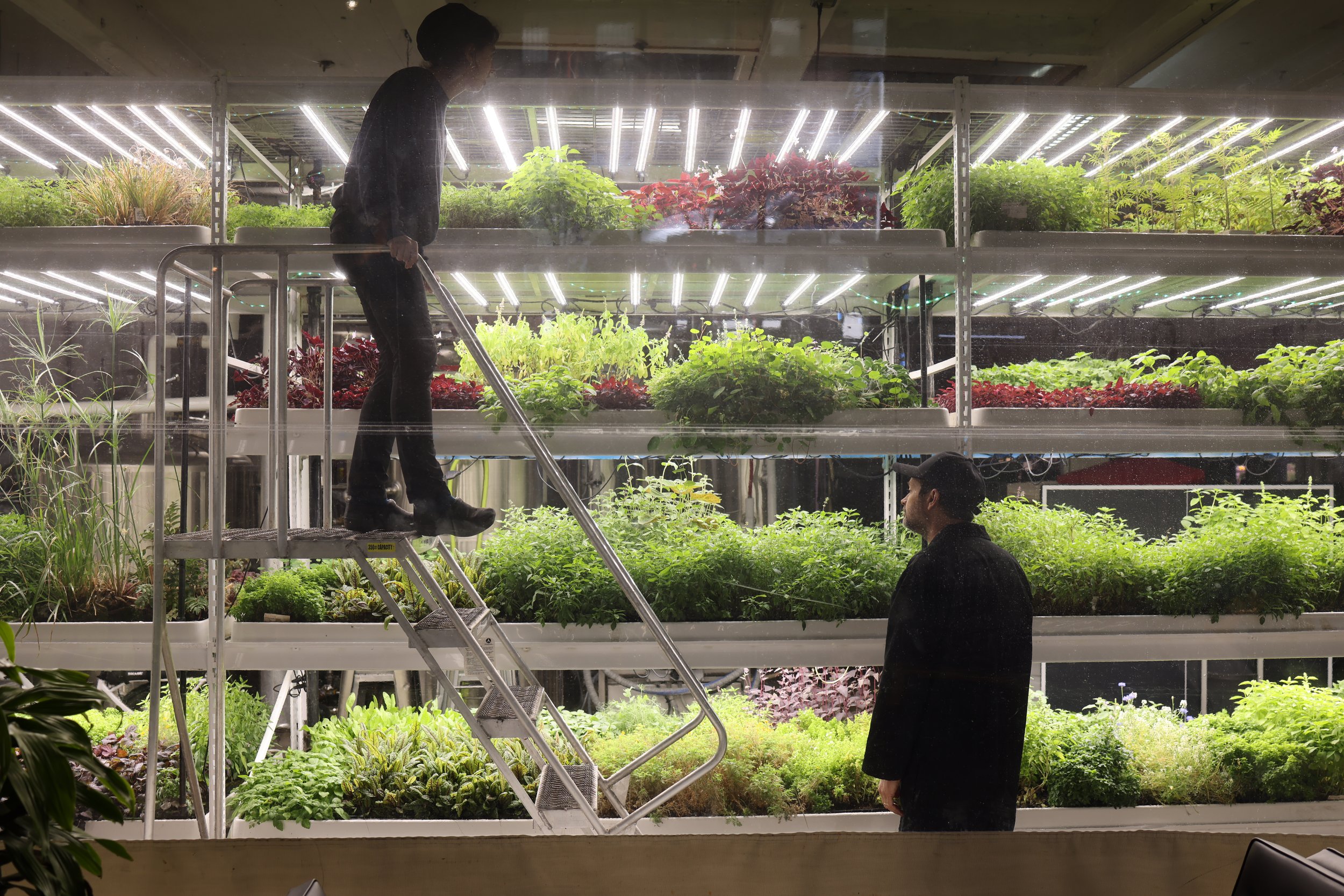
Closed loop supply chains are rare to find in food businesses. The concept of “farm to table” has become a mask for a large carbon footprint, with most restaurants and companies adapting it loosely into their identity. In Prospect Heights, Joe McDowell of Acid Spirits is challenging exactly that. The ingredients for Acid Spirits are sourced in two ways; they either come from a partner restaurant which collects and sorts their food waste, or directly from farms.
Joe got introduced to Farm One through his friend Theo, who used to be a brewer at Grimm Ales. After attending a panel of theirs hosted at Farm One, he got connected to the owner who invited him to set up shop in Prospect Heights. Now, Farm One hosts a distillery and a brewery within their space. For Joe, this has only been a motivation for developing his business further, “It’s so nice because we get to help each other out with equipment and ingredients where needed.”
Acid Spirits’ journey of becoming was not straightforward. While Joe was working at a craft beer bar, he decided to compete in their home-brewing competition, even though he had never brewed a day in his life. The result was as expected, “completely botched”, he describes, with an alcohol level of 2%. However, the failure came with an epiphany that this could potentially be a career path. After college, Joe moved back to his hometown and got a job at the local brewery. After spending three years there, he felt ready to start his own project. With the craft beer industry becoming oversaturated in the late 2010s, he set his eyes on liquor as the next big thing. Upon doing more research, Joe discovered vacuum distillation which set him on the path to set up his own distillery. With motivation and support from his sister, he made the big move to New York. Through connections made in Florida, he met a bookstore owner in NYC, who, funnily enough, was also interested in vacuum distillation. “It felt very serendipitous, almost crazy, because I couldn’t find anybody else who knew about this very cool thing,” he shares in excitement. As they were about to sign a lease in Industry City, the Covid pandemic began and they immediately had to pause operations.
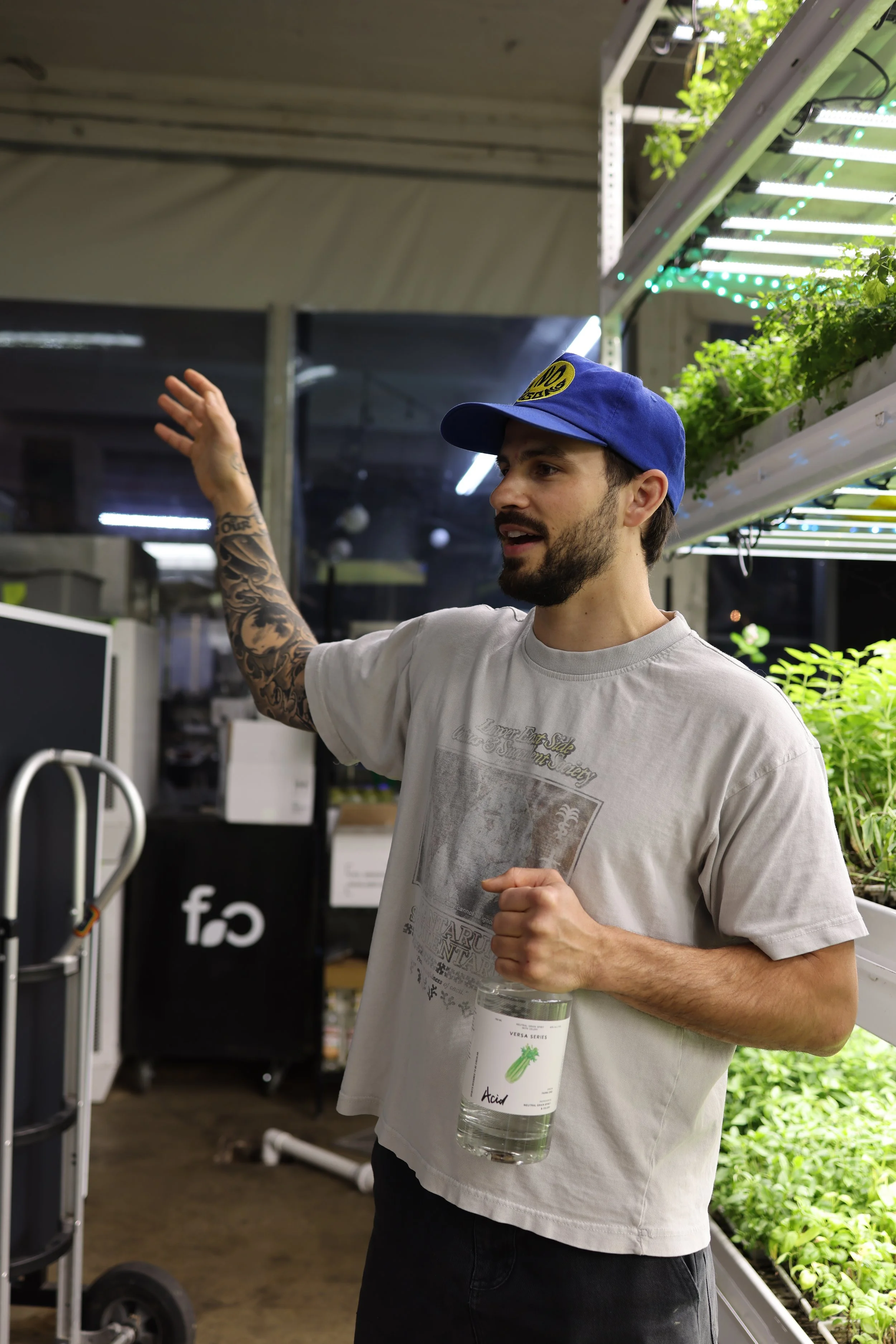
Joe’s commitment to creating a sustainable business was inspiring to those around him too. After getting a loan from a close friend’s dad, he was able to get new equipment and move into Farm One. When he made the move to their space, Acid was able to grow into its first iteration. There was more space to distill and store the product, thus, to also develop the client roster. Initially, Joe was making deliveries on an e-bike, which physically constrained how much he could deliver. That solution was only viable for six months. “Now we’re in the Zipcar chapter,” he says, “Once a week, I’ll rent a zip car and do my rounds. It’s still not financially viable but that’s why I’m applying for grants right now to get a work vehicle.”
At the time, Joe went back to his hometown and mailed all of his equipment down as well. He set up shop in his father’s sunroom, where they got to R & D for what would be the beginnings of Acid, as father and son. The world had come to a full halt, which allowed them more time and space than they would have normally had to experiment. They woke up, practiced distilling and started configuring recipes — and did it all over again every day. When it was time to return to New York, Joe ended up buying his two partners out of the equipment and decided to rebuild Acid by himself. The only great obstacle was figuring out the storage. While waiting to get his licenses, he got a job at Evil Twin Brewery and cut a deal with the owner to make their hot sauce for two years, in exchange for storage space on the second floor.
Even the hot sauce had its own teaching process. It was a formative period for the development of Acid Spirits. The sauce Joe made was using leftover pepper mash from scorpion peppers, one of the first times he played with upcycling as an ingredient procurement method.
“In that process, I was reading ‘Let My People Go Surfing’, which was written by Patagonia’s CEO about their business philosophy, and I felt like everything clicked. Patagonia is the ultimate example and inspiration for a company with a backbone. I dreamt of being the Patagonia of the alcohol space. Their unwillingness to compromise, their dedication to sustainability and accountability is just so inspiring to me,” he explains.
The principles on which Acid Spirits was founded is similar to that of Patagonia’s. Joe is extremely adamant about being transparent about his supply chain, “I think there is such a pathetic attempt to greenwash and communicate sustainability by just using trigger words. I won't ever forget this example. I saw a tshirt at H&M and its tag said 100% recycled, which applied to the tag — not the shirt!” Acid’s pursuit of sustainability is, in this sense, quite noble. Joe is visibly passionate about providing that clarity, “Everything that you do sustainably is typically more expensive than if you take the ulterior option. I think not having investors or the pressure or time limit from that to get the highest return I could, has allowed me to really take my time and explore this space to analyze what my options realistically are. I always say, creative people love parameters because it forces you to find creative solutions. There’s no blueprint for me to follow and I’m trying to use trial and error to see if I can close the loop 100%.”
Transparency, even in areas you're falling short of your sustainability goals, is one of the pillars of Acid. Joe breaks down his approach, “I always use our labels as an example. I could source a label from California that’s made on 100% recycled paper using non-toxic ink and no plastic. But that’s not going to have a smaller carbon footprint than sourcing a lesser quality from the print shop around the corner from my distillery.” Trader Joe’s is also another example in which the carbon footprint is greenwashed through marketing. While people are made to think they’re shopping local, they are actually shopping from a megastore that sources products from all around the world, from Thailand to Canada. “If people don’t really understand where the largest carbon footprint in their industry is,” Joe adds, “they’re just turning the wheels and not really moving the needle. You can't make a change if the business isn't making money. It's just thoughtfulness, transparency and patience with finding a solution to the problems.”
At the moment, Joe is not considering working with a distributor just yet. Choosing who to work with will also be an important part in assessing the sustainability of his business. Besides the concern of carbon footprint and ethos, covering the margins he will share with his distributor is an important part of the equation. “Right now, I just want to get our vehicle, which I hope ends up becoming an electrical minivan,” he says. Exploring demand outside of New York State will determine how much Acid can grow and where the next hub of production will have to be.
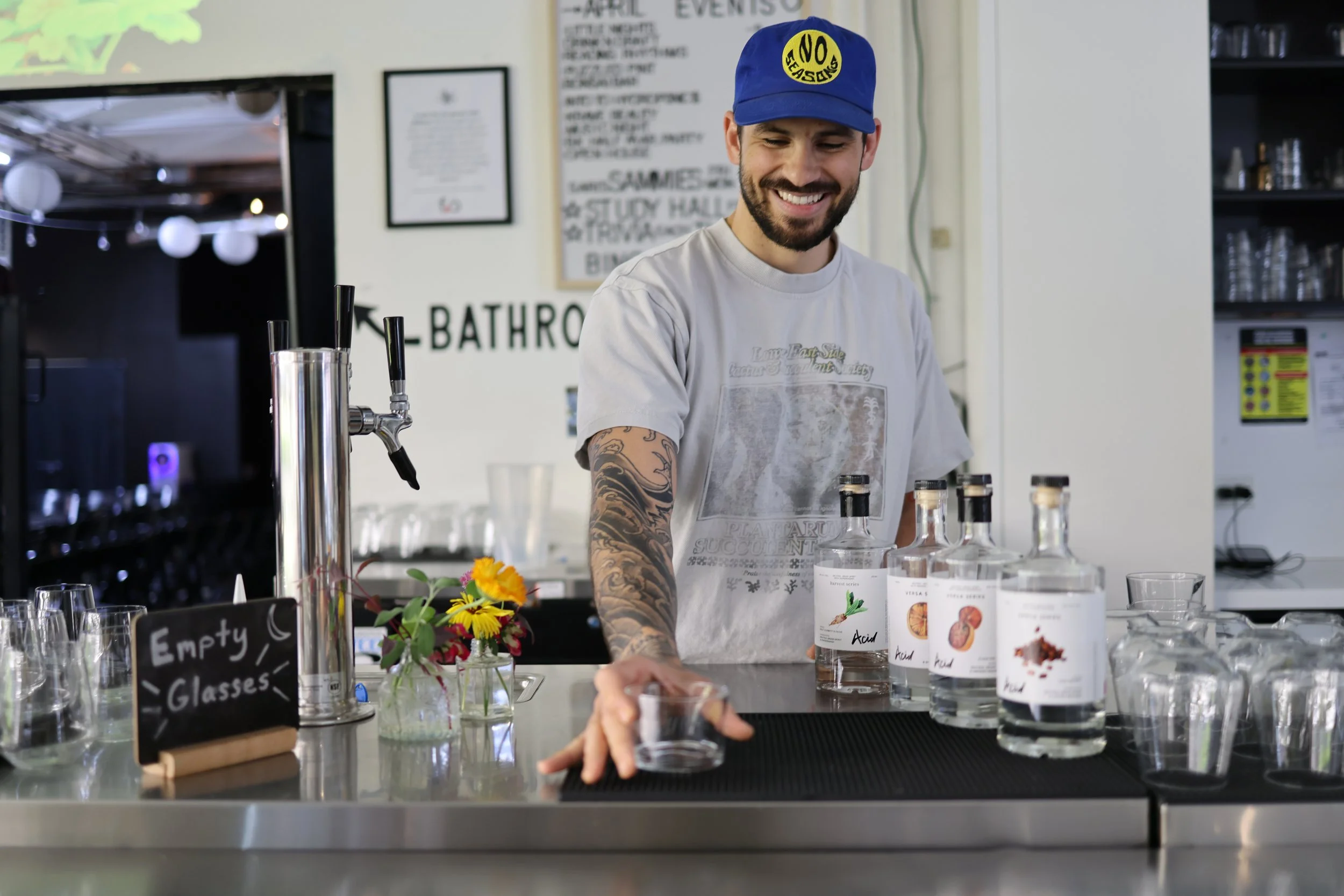
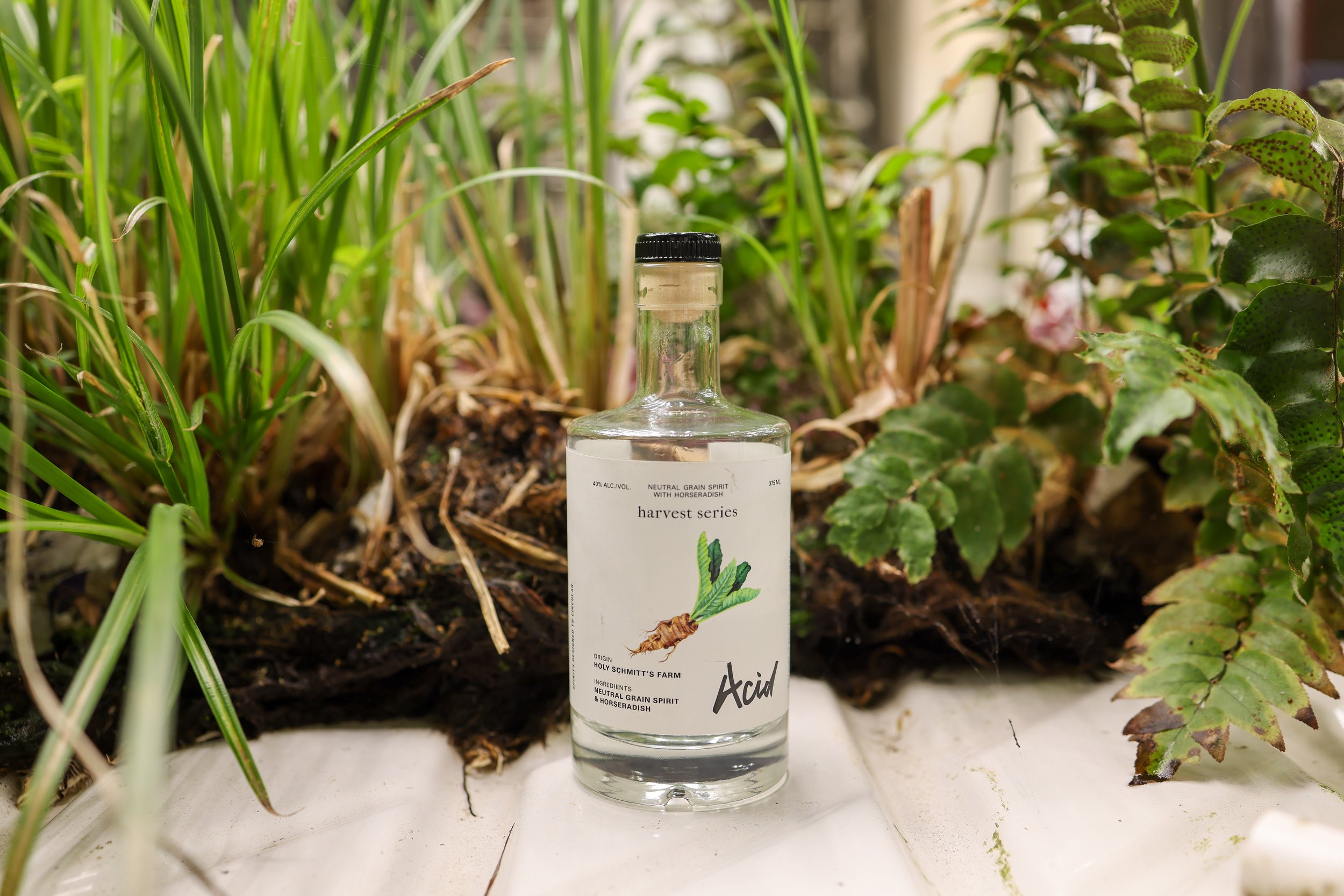
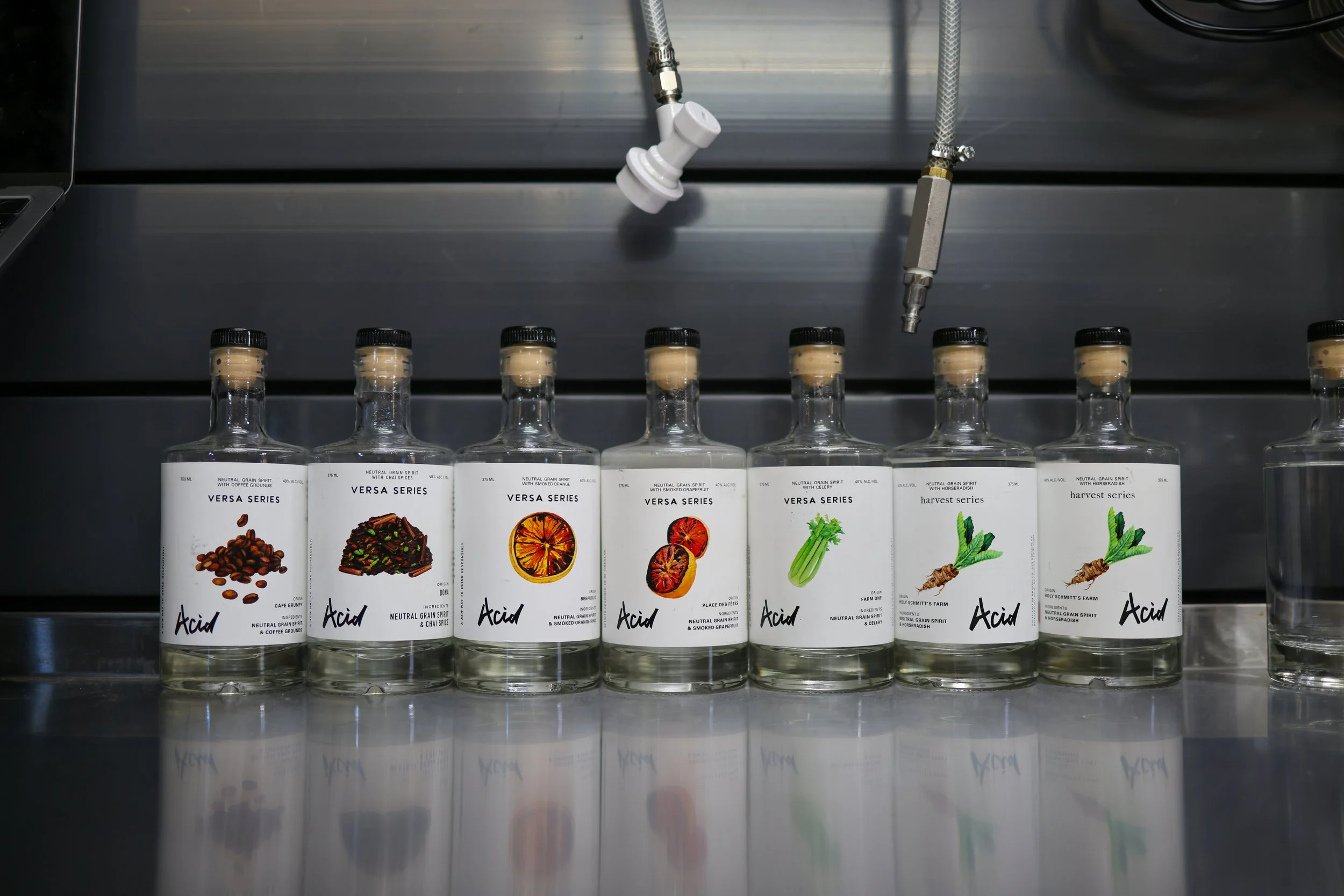
Developing the product line was much smoother than setting up the finances for Acid Spirits. The first to be developed was the harvest series, the pepper and quince spirits to be precise, in which ingredients are purchased fresh in season and their waste is upcycled. Soon after, Joe worked on the coffee spirit per a friend’s recommendation. At first, he was collaborating with Sey Coffee in upcycling the grounds from their iced coffee, but their heat-induced brewing method did not yield ideal results. Using heat detracts a lot of flavor, which in turn does not allow for the grounds to impart much onto the spirit. When the coffee formula was figured out, Joe launched the Versa series, which led to him working with restaurants like Places des Fetes.
Unfortunately, not every project works out due to the sensitive nature of the relationship the restaurant has to build with Acid. “I've had dialogue start with a couple accounts but we couldn't find a way to make it make sense. I'm almost working backwards to see where there's a lot of waste and see if I can turn that into a spirit. It’s also hard to convince restaurants to separate their food waste and make sure the waste they give to me is not contaminated,” Joe shares. One collaboration that did not work out was with Blue Hill Stone Barns, in which they proposed their leftover table wine gets upcycled for a spirit. However, it was impossible to get a distinct pop of flavor from day-old wine. Time, it seems, is a very important parameter of determining what can be turned into an Acid product. Methodically, he prefers to pick up his ingredient immediately after the restaurant has processed it so that it can be safely used to extract flavor. Joe adds that continued availability of the waste that’s being upcycled is key, “I used to have an olive spirit that I really loved, but I couldn't keep it going because I couldn’t scale the production. I was getting leftover olive brine from Places des Fetes and olives from Farm One, but between the two places, I couldn’t produce enough and the demand was too much. So many people already use their olive waste. Brine is not necessarily a byproduct, it’s more of an ingredient.”
Although there is a lot of trial and error, there is indeed a grand plan for Acid’s future. Joe lays out each step, “I want to identify a core line of four to six flavors that can be produced across the board, rooted in upcycled food waste and brought to scale. Then I want the harvest series to be the storytelling line and highlight the nuance of foraging. Similar to wine, to show the terroir of the Northeast. These ingredients would be native to here. Everything we produce in the Northeast hub, in New York, would ideally only be distributed in the Northeast as well. Then I can work on a second hub out west in California. With the core line, you'll be able to get those anywhere, but with the harvest series, you would only be able to get it in the region in which it is being produced. From there, I would love to see if exporting outside of the United States is feasible with our business model.
Further, I want to continue upcycling every ingredient we are leftover with along the process of distilling, possibly making clothing dye from the extremely concentrated pulp we’re left with. It’s about figuring out how much we can stretch the ingredient along the way and find many uses for it. For instance, the douglas fir spirit we make for Golden Ratio – the leftover product in the rotovap from that is pure douglas fir extract. It could easily go to a perfumery or candle maker, there’s definitely something there.”