
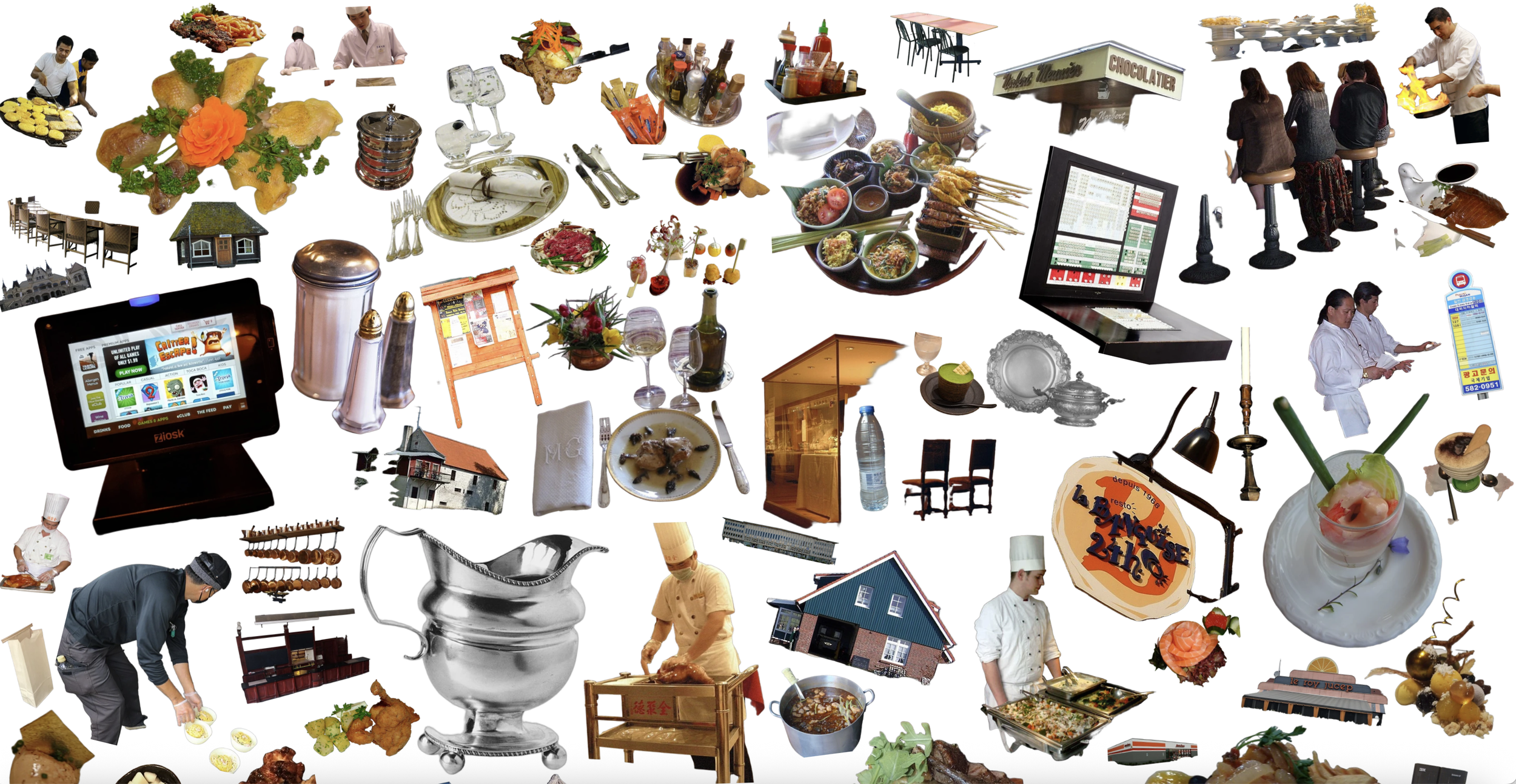
Image generated with Wiki Spy
Did We Forget About Artisanal Intelligence?
Text by Karissa Simchick
As AI enters the dining room, restaurant workers fade further into the background.
I can count the occasions I’ve been expected to wear all black on one hand: my grandfather’s funeral, my stint on crew in middle school theatre, and the summer I worked in a fine dining restaurant.
Black is the color of discretion. In restaurants, it’s part of a subtle and strategic concept known as sprezzatura, or the art of making effort look effortless. When executed properly, it feels like magic. Diners, two glasses of wine and three courses deep, forget the outside world exists. They also forget the restaurant staff exists. Good hospitality happens when guests are oblivious to 90% of the service work that orchestrates their experience.
It is, in many ways, similar to a theatre production, though audience etiquette doesn’t translate as fluently. For instance, phones are almost always allowed at the dinner table. This introduces a unique obstacle for restaurant workers not faced by other industries: it splits the consumers' trust between their beloved devices and the strangers serving them. Technology’s integration into the restaurant experience challenges an essential pillar of sprezzatura, making diners feel like they’re puppeteering the experience themselves using the expertise available at their fingertips. Turns out, for sprezzatura to work, the guest needs to believe the experience is happening to and for them, not by them.
While technology has offered several points of contention to argue about within the restaurant industry, nothing has provoked as much fear as the current AI revolution. Restaurants have already reported practical failures, including Google’s AI inventing menu specials that never existed. Diners have raised concerns about how reservation platforms like OpenTable and Resy collect and leverage customer data. Fine dining experiments like Grant Achatz’s AI-generated “Chef Jill” have sparked questions about whether AI fosters genuine creativity or merely regurgitates existing ideas, reinforcing the same culinary hierarchies that have long dominated the industry.
“Our chef doesn’t build a communicative menu,” says Kate Casey, who has worked as a server in New York fine dining for nearly half a decade. “It’s implied when he writes the menu that you’re going to talk to me. But people will order based on photos online or what ChatGPT tells them, and I’m never quite sure where ChatGPT gets its understanding of our dishes. None of our cooks, chefs, or servers use it, so there’s no direct way for it to learn what our menu actually means.”
Restaurant staff aren't always sure where AI is getting its information, which means diners have even less visibility into the systems shaping their experience. How is AI operating behind the scenes of the dining room? Who is controlling these programs? And what happens if something goes wrong?
To understand this new world of AI-adulterated sprezzatura it’s important to acknowledge that balancing human-centered service with data-driven business has always been the crux of the restaurant industry. AI doesn’t change much about this dynamic except that it invites a third-party to the table—one that, at its best, alleviates stress and unnecessary labor, and at its worst, takes advantage of the existing parties for its own profit, inciting fear as it does. The rapidity of technology’s evolution and astronomical profits acquired by Big Tech contrast starkly with restaurant laborers who are trained to be meticulous while remaining underpaid.
Before writing this, I approached each conversation full of concerns about technofascism and Erewhon-esque cynicism. Yet speaking to hospitality professionals, I became more hopeful. In focusing so intensely on the capabilities of technology, it's easy to overlook the intelligence, adaptability, and care of the people who make restaurants work in the first place.
Paulo Coelho, service director at Lei, recently named the James Beard Foundation’s 2026 Best New Restaurant, likes to say he works in “expectation management.” While the fundamentals of his job haven't changed much with the integration of AI, diners' expectations have. “I see guests who walk in with no idea what Lei is, and others who’ve been dreaming about dining here for a year,” he says. “My job is figuring out how to manage those expectations and make sure they have the experience they came for.”
What Coelho describes is difficult to automate. It depends on observation, timing and the kind of situational judgment hospitality workers develop over years of service. Much of the public conversation around AI frames technology as a threat to restaurant labor. In practice, the greater risk may be that it obscures the value of the labor already there.
Restaurant professionals understand the importance of human judgment because they exercise it every day. Diners, meanwhile, are increasingly encouraged to outsource that judgment to algorithms, recommendation engines, and predictive technologies. AI threatens sprezzatura in this sense because it changes how guests interact with expertise.
From a purely business standpoint, restaurateurs are finding practical value in AI systems. Reservation and table-management platforms help maximize seating charts and service flow. AI-powered phone systems allow diners to reach restaurants outside regular operating hours, extending hospitality beyond the confines of a shift. Some restaurant groups have also adopted targeted marketing tools such as LoyaltyAI, which gathers feedback from guests who might otherwise never share their opinions, helping operators correct mistakes and strengthen relationships. Additionally, inventory and waste-management systems make it easier to navigate the industry's notoriously thin margins.
None of this erases the legitimate concerns surrounding automation, surveillance, or the concentration of technological power, but for many restaurateurs, AI is less of a philosophical question than a practical one: if a tool can reduce administrative burden and create more time for human connection, it’s difficult to dismiss outright.
“We use it to take the busywork out of the shift for a manager and get them focused on being on the floor servicing the employees and servicing the guests,” says Kelly MacPherson, Chief Technology and Supply Chain Officer at Union Square Hospitality Group. “A day in the life of a manager, you've got preshift work, you've got service work, and then you've got post-shift work. If we can streamline the pre- or post-shift tasks, we can free up their time to improve the quality of the shift. They didn’t get into this industry to sit in an office doing administrative work. They got into it for hospitality and service. We want to enable them to do what they’re great at.”
For diners, AI related anxieties often crystallize around data privacy. These concerns point to a broader unease about technology's growing presence in everyday life. While OpenTable and Resy both offer user settings to opt out of data sharing, restaurants still occasionally get blamed for mishandling data, despite most diners being oblivious to what information these platforms are truly collecting.
“We collect dots to connect dots,” MacPherson says, slashing the idea that a restaurant group of that caliber would exploit guest data. “It’s my job from a technology, security, and compliance perspective to make sure that we put in the right controls and governance to protect guest data. So when we look at that data, it's to deliver a better enlightened hospitality experience.”
For MacPherson and many others in the restaurant business, technology is not a substitute for hospitality but an extension of it. The collection of customer data does not serve any personal purpose for hospitality workers. From a restaurateur's perspective, guest data is valuable precisely because hospitality is relational: understanding customers allows restaurants to serve them better and build loyalty in an increasingly competitive industry.
“It’s almost like planning seating arrangements at a wedding,” Coelho says. “I’m constantly figuring out who needs attention, who wants privacy, who’s lingering, who’s in a rush—and sometimes, who hates who. I’ve seated people next to the person who fired them the week before and thought, ‘Okay, I need to remember that.’ It’s not really my business, but it affects the dining experience. If you’re passionate about hospitality, you’re passionate about how people experience your restaurant. Guest notes are something restaurants have done for years – they allow us to keep track of small preferences and plan ahead to avoid safety issues.”
Ultimately, the diner benefits from both novel technologies and hospitality’s human touch—most of all when neither is conspicuous. Restaurants have always balanced efficiency with intimacy and systems with spontaneity. AI may alter the tools available to restaurateurs, but it cannot replicate the feeling of being genuinely cared for by another person.
Which returns us to the paradox at the heart of hospitality: the better the service, the less visible it becomes. Sprezzatura depends on labor disappearing into the experience, but technology complicates that illusion by drawing attention to the systems operating behind the scenes. Restaurants are not tech-reliant entities. They function through communities of people whose skillset includes reading individuals, anticipating needs, recovering from mistakes, and making strangers feel welcome. The question is not whether AI belongs in hospitality, but if it can remain subordinate to the human expertise that has always made hospitality possible. That choice, it seems, lies particularly in the hands of the diner.