
Proof of Care
Text by Karissa Simchick
Today’s most distinctive meals are crafted not just by chefs, but also by ceramicists.
Increasingly in fine dining, restaurateurs are sourcing artisanal ingredients that aren't edible at all. While spatial arrangement and plating have long been hallmarks of a good restaurant, the white porcelain canvases of the past have given way to custom ceramics. Tablescapes have become central to the definition of a restaurant’s identity. More than vessels for food, they tell a story while meeting the technical demands of service. While a stamped signature clues diners in on the human hands that shaped the serveware, the intentionality and craft of the ceramicist extends far beyond the object itself.
Jono Pandolfi, whose name has become synonymous with modern restaurant ceramics, designs with two questions in mind: How does food look on it, and can it withstand the demands of service? His work—seen everywhere from Eleven Madison Park to the fictional dining room in FX’s The Bear—has helped redefine tableware as essential to hospitality rather than a backdrop. “It’s because of something called product-market fit,” he says. “The product I design is what the market wants and continues to want.”
Today, his ceramics appear in more than 700 restaurants worldwide, challenging the idea that artisanship and scale are incompatible. “I consider myself incredibly fortunate that I designed a collection over 15 years ago that still drives the business today,” he says.
This market fit stems from the fact that ceramics are one of the few elements of service that affect every member of the restaurant ecosystem. Diners experience them most directly — behind the scenes, plateware shapes the operations of both front of house and back of house. For employees who handle hundreds of pieces each shift, functionality often matters more than appearance. The plate lends different questions for every one that touches it; dishwashers consider utility, chefs consider plating and volume, servers mostly consider size and shape.
Brooklyn-based ceramicist Stiliani Moulinos of Noble Plateware embraces this reality, designing pieces that serve both diners and staff. “My favorite part of seeing our designs in action is watching them thrown around the kitchen,” she says. “Our stuff is super durable.” Durability is only one measure of success. “It’s one thing to say it and another to see how it operates within the restaurant,” she adds, “Servers will tell you, ‘We love this plate, but it’s not deep enough and the juices get everywhere.’” For Moulinos, the real test of a design comes not in the studio but on the restaurant floor, where beauty must withstand the practical demands of service.
At Kabawa, that philosophy takes the form of a custom dip plate that combines five vessels into one sculptural object. Designed to reduce the number of trips servers make between the kitchen and dining room, it transforms an operational challenge into a visual centerpiece. The result is functional art, where utility and appeal are inseparable.
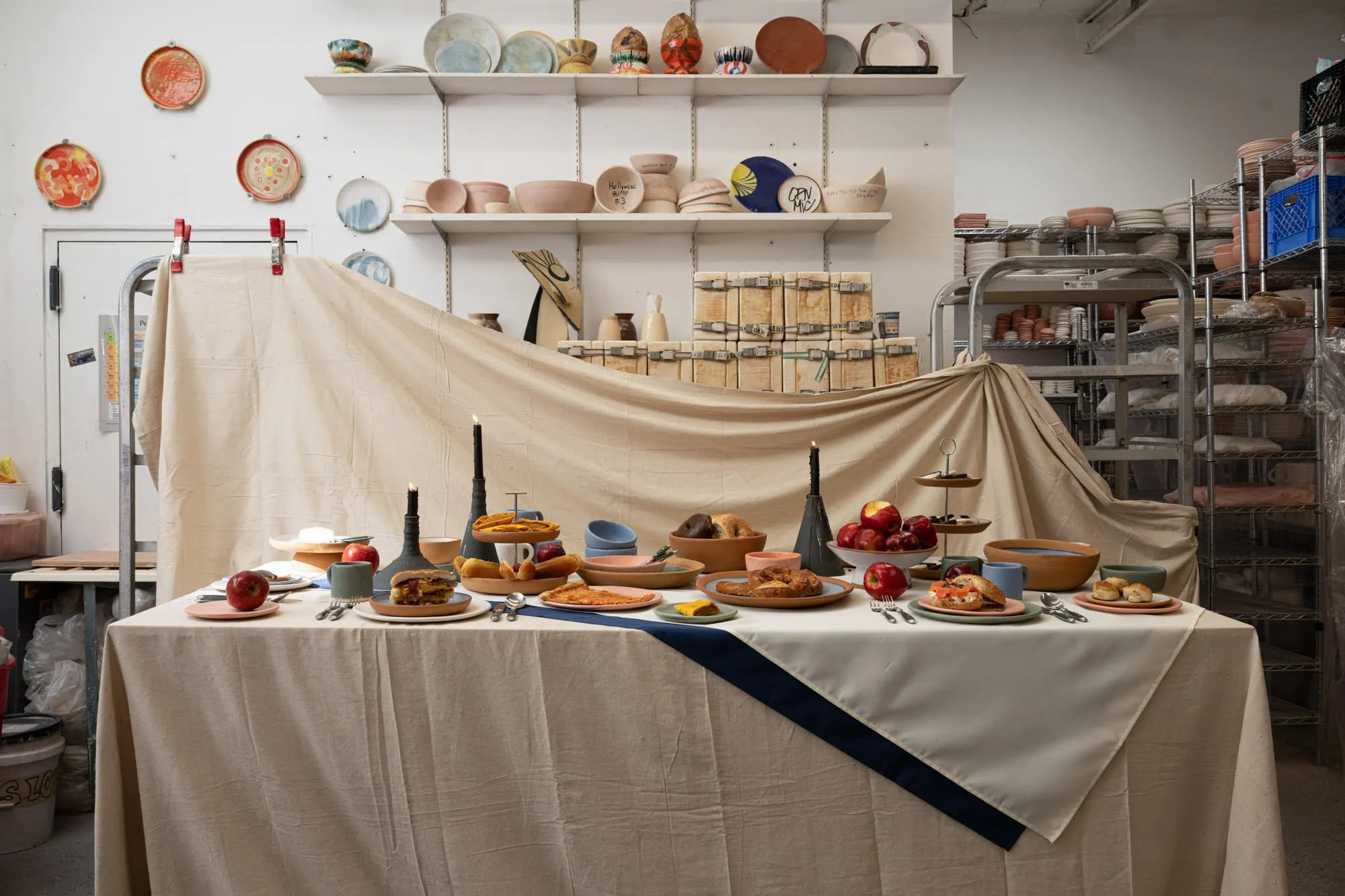
Once form and function are established, the artist has room to play around. “We hide Easter eggs around the bar,” Moulinos says, referring to the custom coconut holders she created for Kabawa, adorned with references to Caribbean history. “There’s a frog for Puerto Rico and references to the Haitian Revolution. Those pieces took a lot of research and it was an honor to make them.”
Practicality and cultural authenticity come into a push and pull in plateware design. Beyond Pandolfi’s strategic approach and Moulinos’s utilitarian storytelling, there is a deeper connection between consumer and creator. Tableware is a sensual part of both the cooking and dining experiences. Customization allows for a collaboration between the chef and the maker that dictates how a dish should be consumed.
"We'll first play around with the shape: is it a plate or a bowl? Then the diameter. And then if the course has a sauce it'll need something to catch the sauce. You want something raised," says Chicago-based artist David T. Kim, describing his long-standing relationship with chef Sujan Sarkar of Michelin-starred Indienne. "I think it's really cool he knows how to play with the visual landscape of the plates and his food. So we start there, and then I'll throw in textures or lines or carvings into the piece to give it a more unique look that follows his lead."
The physical effects of this synergy are easily felt, but its ancestry is less visible. That's where the maker's mark comes in. Flip over a plate and it leads not just to an artist, but to a personal history. "My father is a sushi chef," Kim says. "I'm a restaurant kid. My parents taught me to come early and stay late. It's all the little things before you actually get to cook—ordering supplies and so much prep work—that you watch come together for one ephemeral dish."
Like Pandolfi and Moulinos, Kim's studio operates much like a kitchen. Similar to a chef's menu, his ceramics express a distinct identity. "Being Korean American, I definitely had that sort of identity issue," he says, "but I found a really strong connection to Korean pottery and the techniques involved in making pots because, for them, it wasn't fine art. It was mostly functional for everyday use." Kim draws inspiration from Buncheong, a traditional Korean technique in which white slip is layered over dark clay to create expressive, spontaneous patterns. "They were able to create such unique pieces and variations of bowls," he says. "The artist's hand is in the piece."
This is what diners are responding to when interacting with craft within the landscape of the new New York restaurant model. “Why does grandma’s cooking taste so good?” Moulinos asks. “Energy is everywhere. There is a human essence that people notice.” Long before food reaches the table, countless hands have shaped the experience, from chefs and farmers to servers and ceramicists. The best restaurant ceramics make those invisible contributions tangible, encapsulating the essence of the artists that produced them. In an industry increasingly defined by automation and scale, they offer something distinctly human — proof that care can be felt.
Photography courtesy of Noble Plateware