Makers —
Imagining a Different Future for Chocolate
Considering that you don’t come from a traditional culinary background, what was the impetus for changing your career in this direction?
Makers began with a clear gap in the market. Chocolate has historically existed between two poles: industrial products that prioritise convenience over quality, and luxury chocolate that, while refined, has remained anchored in traditional formulations. There was very little in between that delivered both exceptional taste and clean ingredients. My background in chemical engineering shaped how I approached this. Rather than seeing chocolate as a fixed craft, I approached it as a system that could be re-engineered. Makers is built on the idea that indulgence and clean, healthy ingredients are not mutually exclusive, and that luxury chocolate can evolve to meet a more modern, health conscious and informed consumer.
Your shop has a very specific approach to chocolate: no refined sugar or dairy, highly processed oils, flavorings or artificial ingredients. How has this presented itself as a challenge so far?
Characterised by our founding principle – to marry craftsmanship with clean ingredients and exquisite flavour – Makers is free from refined sugar, dairy, wheat, seed oils, artificial preservatives or additives and artificial colouring. This required a complete rethinking of chocolate making from first principles. Most traditional techniques rely on dairy, refined sugars, emulsifiers, stabilisers so removing them meant we could not adapt existing recipes, we had to rebuild them entirely.
What that led to was a new way of working. We developed our own methods to achieve the same level of texture, quality and indulgence using a different ingredient framework. Today, that approach is not a limitation but a point of strength. It allows us to create chocolate that delivers on taste while being made with health-conscious ingredients you can feel good about eating regularly.
This also plays into the fact that, above anything else, everything at Makers is a truly artisanal product. Having so many handmade components and a large product portfolio, how has the need for human labor shaped your business so far?
The Makers team is at the centre of the business. The quality of what we do is entirely shaped by the people behind it, both in the atelier and in the shop. In the atelier, it is about artisanal expertise, precision and a deep understanding of the craft. In the boutique, it is about hospitality, how people are welcomed, guided, advised and looked after. Across both, what matters is care, attention to detail, energy and kindness. That human element is what defines the experience. It is what allows the product to feel considered at every stage, from how it is made to how it is presented.
Makers has been open for over a year now, but you chose an interesting time in the industry to work with one ingredient that is now highly unstable in availability and quality. Were you aware of the risks that come with working with cacao and chocolate?
Cacao is undergoing a structural shift, driven by climate pressures and increasing global demand. Rather than seeing this as a risk, we see it as a defining moment for the industry. From the beginning, Makers has operated outside of the commodity model, working with bean to bar producers who source directly from single origin farms and prioritise consistency and quality. This approach gives us greater control over inputs and positions us well in a market that is increasingly moving towards traceability and origin-led sourcing.
At the moment, what does your supply chain look like?
Our supply chain is built around direct relationships and high-quality sourcing. We work with a bean-to-bar producer who sources cacao directly from individual farms, focusing on single origin cacao varieties selected for their flavour profiles. These range across South and Central America, Southeast Asia and Central Africa, each bringing a distinct character.
This philosophy extends across all ingredients. Everything is chosen for quality, traceability, and taste within the final product. Lastly, our health-forward, clean ingredient framework naturally requires a more diversified supply chain. It spans a network of suppliers rather than relying on a small number of conventional large-scale ingredient providers, and enables us to work with special ingredients like maca, cassava flour, coconut sugar, grass-fed collagen to name just a few.
At Makers, Noor and Alex set out to achieve the impossible: to make delicious chocolate that doesn’t sacrifice texture or flavor while using health-conscious ingredients. Despite the limitations they put on themselves by choosing to make 90% of their ingredients from scratch, Makers tastes better than your favorite chocolate bar. When you try one of their “candy bars” filled with functional ingredients, like ashwagandha or maca powder, the delicate nature of the fillings and the thin shell leave an otherworldly taste on the palate. For some, they may feel decadent. If you are a chocolate lover like me, you will keep wanting more.
When it comes to the operations front, Noor handles the creative direction and management, and leaves the kitchen to Alex, who has plenty of experience as a chocolatier. Their dynamic works perfectly - Noor pushes Alex to his culinary limits and Alex delivers each time. When Noor and I catch an opportunity to chat, I ask her about the journey of opening Makers.
Text by Ebru Eltemur
How has your business been affected by export and import restrictions? Particularly with the American- led war on Iran?
Like most businesses operating globally, we have seen shifts in lead times and costs. However, our approach has been to build resilience through strong supplier relationships and forward planning, but there’s only so much we can control as a growing business. Working with natural, clean, healthy ingredients and single origin cacao already places us on a higher cost base, as we do not take shortcuts in sourcing or production. The war in the Middle East has created additional cost pressures across our supply chain, compounding those underlying costs.
Yet, the future of chocolate is moving towards greater transparency, higher quality sourcing, and a more informed consumer. We expect a continued shift towards products that emphasise origin, craftsmanship, and ingredient integrity.
Do you think the “from scratch” philosophy is what sets Makers apart from other chocolatiers? Or is it the process and creativity, rather than the end-product?
What sets Makers apart is the combination of taste, quality and clean ingredient philosophy. From the outset, the ambition was to create chocolate that delivers the same level of indulgence as traditional luxury chocolate, but using a completely different ingredient framework. If it does not taste exceptional, we do not pursue it. And if it cannot be achieved with our ingredient philosophy, we simply do not make it. That approach naturally led us to making everything from scratch, from caramels to pralinés and beyond. By controlling every component, we are able to innovate at a deeper level, creating a product that is differentiated in flavour, texture and overall experience.
Your Lebanese background shines throughout the design decisions you made at the physical shop in Chelsea. How did you select the artisans and designers you wanted to work with?
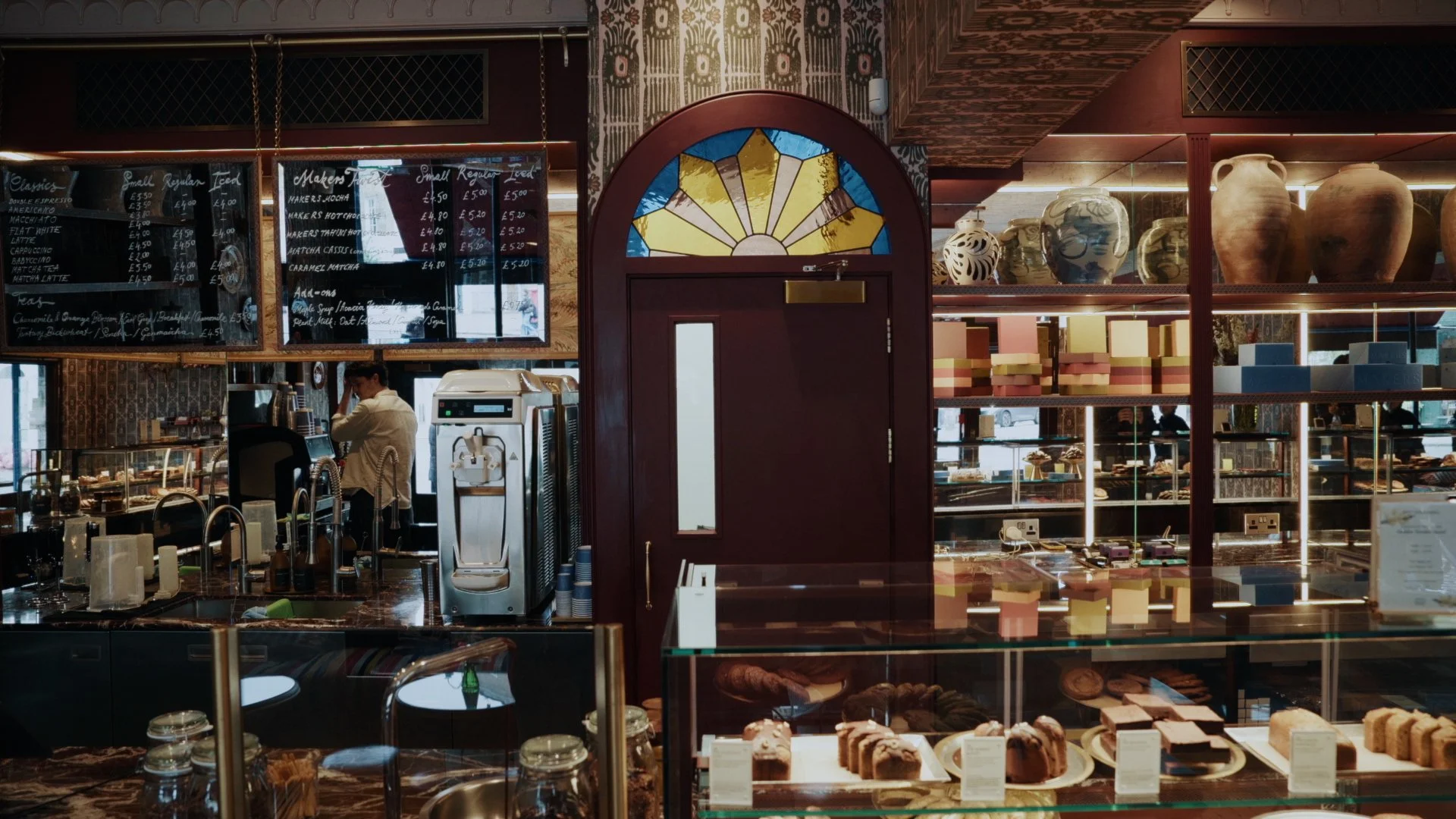
The design process was about creating something that drew on a sensibility of old Lebanese house design. I grew up in a culture with a deep appreciation for materials, craftsmanship and detail, and that naturally shaped how I approached the space.It was also rooted in highlighting craftsmanship. We worked with artisans who have a strong relationship with materials, creating a space that feels layered and intentional. From hand-painted Delft tiles by Petra Palumbo and hammered copper serverware crafted by a family workshop in Lebanon, to the handmade mosaic by William Newman and hand-painted signage, every element was chosen for the level of care and craftsmanship behind it. There is a richness to the interiors and the intention was to create a space that feels warm, expressive and lived-in, while still being refined.
Another important aspect of the Makers experience is the packaging. How do you feel, knowing that people who share a similar heritage to yours, feel connected to the brand in that way?
That is incredibly meaningful to hear. Knowing it resonated in that way makes it feel like the intention behind it was translated. Our approach to design plays a big role in that. The interiors are more layered and expressive, whereas the packaging is intentionally more restrained. We work with our brand colours and focus on subtle details like texture, blind embossing and material quality, so it never distracts from what matters most, which is the chocolate itself.
The idea is that the packaging supports the experience. It frames the moment of discovery, of choosing, opening, indulging and savouring, without overpowering it. And once that moment has passed, it naturally becomes something you keep, a small object that carries the memory of it. There is also something very familiar in that instinct to hold on to well-made things and give them a second life.
What are some of the material decisions you made when deciding on your packaging?
We prioritize paper-based materials wherever possible, both for their tactility and their environmental impact. Our packaging is designed to be recyclable or compostable, with compostable coffee cups and lids, and we avoid unnecessary components such as magnets or mixed materials that make recycling more difficult. The focus is on creating something that feels considered and high quality, while remaining responsible in how it is produced and disposed of.
Noor’s Lebanese heritage does not only reflect in the design of the shop, but also in their customer service approach. In Lebanon, food is not transactional: it’s about community, generosity, curiosity and time. They apply the same philosophy to Makers, where they encourage people to ask questions, to taste and take their time.
Noor shares that for her, legacy cannot be built upfront - it is the result of consistency over time. She sees significant opportunities for expanding the Makers universe with new products, experiences and locations.
On the other side of the business is Chef Alexandre Vandale. Noor explains that finding the right partner was critical and Alex came from a classical luxury chocolate background, having trained in some of the most respected maisons. What made their partnership work was his expertise and highly experimental, solution-oriented mindset. From the beginning, they were focused on developing processes that would allow Makers to achieve the texture, depth and complexity of traditional chocolate using a health-based ingredient framework.
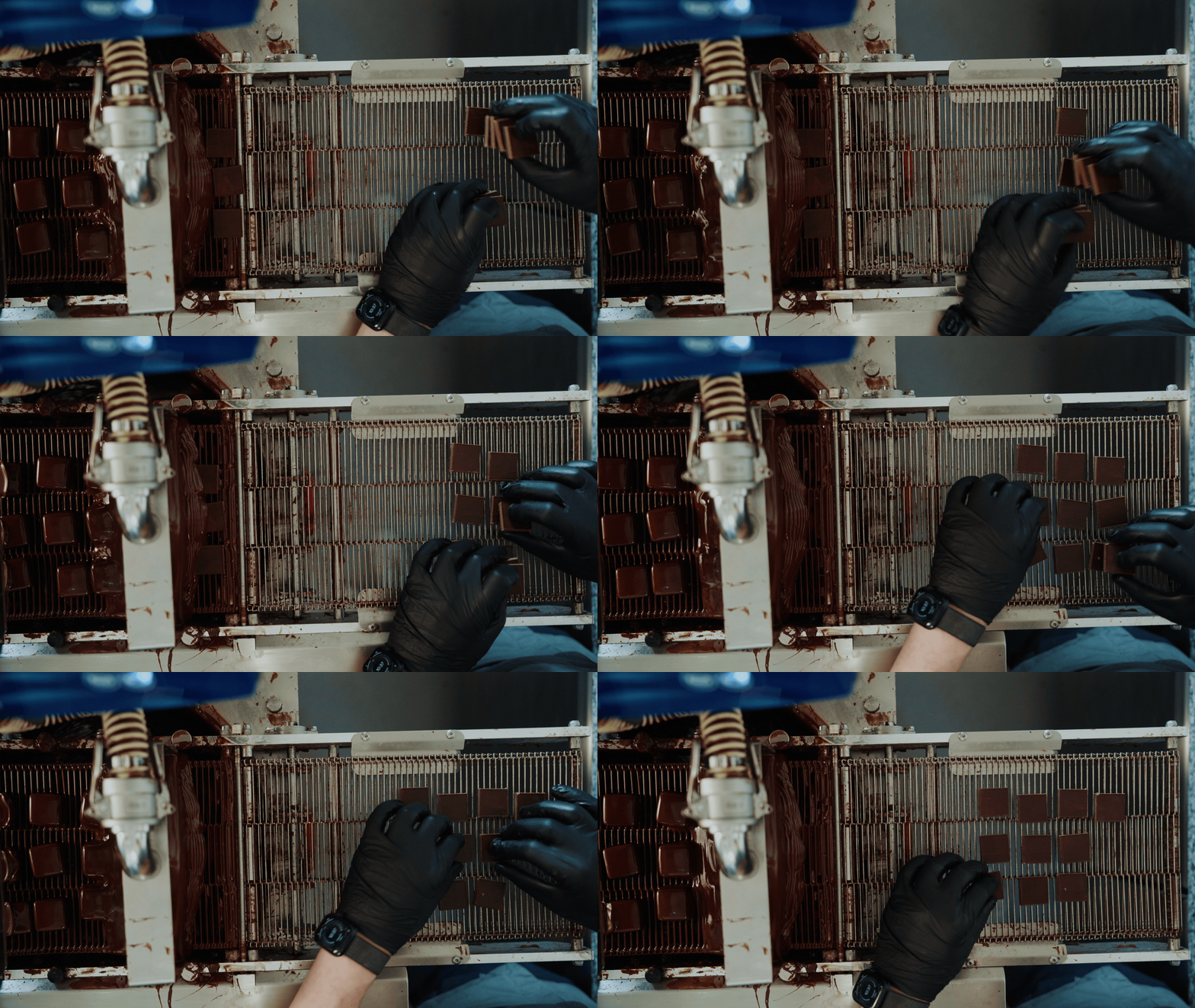
When we are filming in their production kitchen, Easter has already passed. Chef Alex explains that it took almost one year for him to develop the specialized collection for the holiday. “I’m already working on the collection for Christmas 2026. We try to add a couple of different seasonal products during the summer too and change up ice cream flavors,” he says. Since they don't utilize any traditional ingredients and emulsifiers like glucose, engineering the recipes becomes a bit complex. Before they can develop the flavor, they need to find a method that is repeatable and yields consistent results. “I also have to think about shelf life, which is a major concern for chocolate, ” he adds, “We usually need to prototype a product around 10 times”.
At Makers, sourcing non-dairy chocolate is the least of their problems. At first, it can have a surprising taste, but Alex enjoys it more than generic chocolate. “In traditional chocolate, since so much flavor was lost particularly in the past 50 years, they started to mix batches of cacao beans to create a milder flavor that everyone can use. That is the chocolate flavor that consumers are used to. You can keep mixing the batch until you reach that mid-level flavor and you can over-roast it to soften the cacao. It’s similar to coffee”. Alex considers himself a foodie. Similar to coffee-heads with their coffee, he enjoys different types of chocolate that do not necessarily fall in the mainstream.
Makers’ current number of suppliers is close to a hundred and they try to work with local small businesses if they can find the right products. Alex’s big rule is that everything they purchase has to be tested. One of the reasons why they end up making ingredients from scratch is the standard to which they hold their ingredients. Consumers are rarely aware of the tedious work that goes into hand making chocolate. Alex believes the restaurant industry luckier when it comes to pricing, because they can justify it through awards and service.
He is also interested in the politics of chocolate. He gives me a brief history lesson, explaining that the Second World War was a turning point for cacao. ”They engineered the trees to grow faster and produce more. They made new plantations in Africa to destroy the original trees and thus, reduce the quality. An absolute nightmare,” he shares. “They also put more sugar in chocolate because the cacao was losing flavor”. For many reasons, people don’t consider chocolate a luxury item. They gravitate towards the cheaper options. Alex explains that “to have a longer shelf life in chocolate, you need to have very little water inside, but the water creates the taste. The more sugar you put, the longer the shelf life will be. For a lot of big brands, it’s also a way of reducing waste and allowing the chocolate to stay on shelves longer. Here, we believe in a shorter shelf life that preserves the taste and quality”. As a chocolatier, Alex trained with Pierre Marcolini, who has been dramatically influential in shaping his approach.
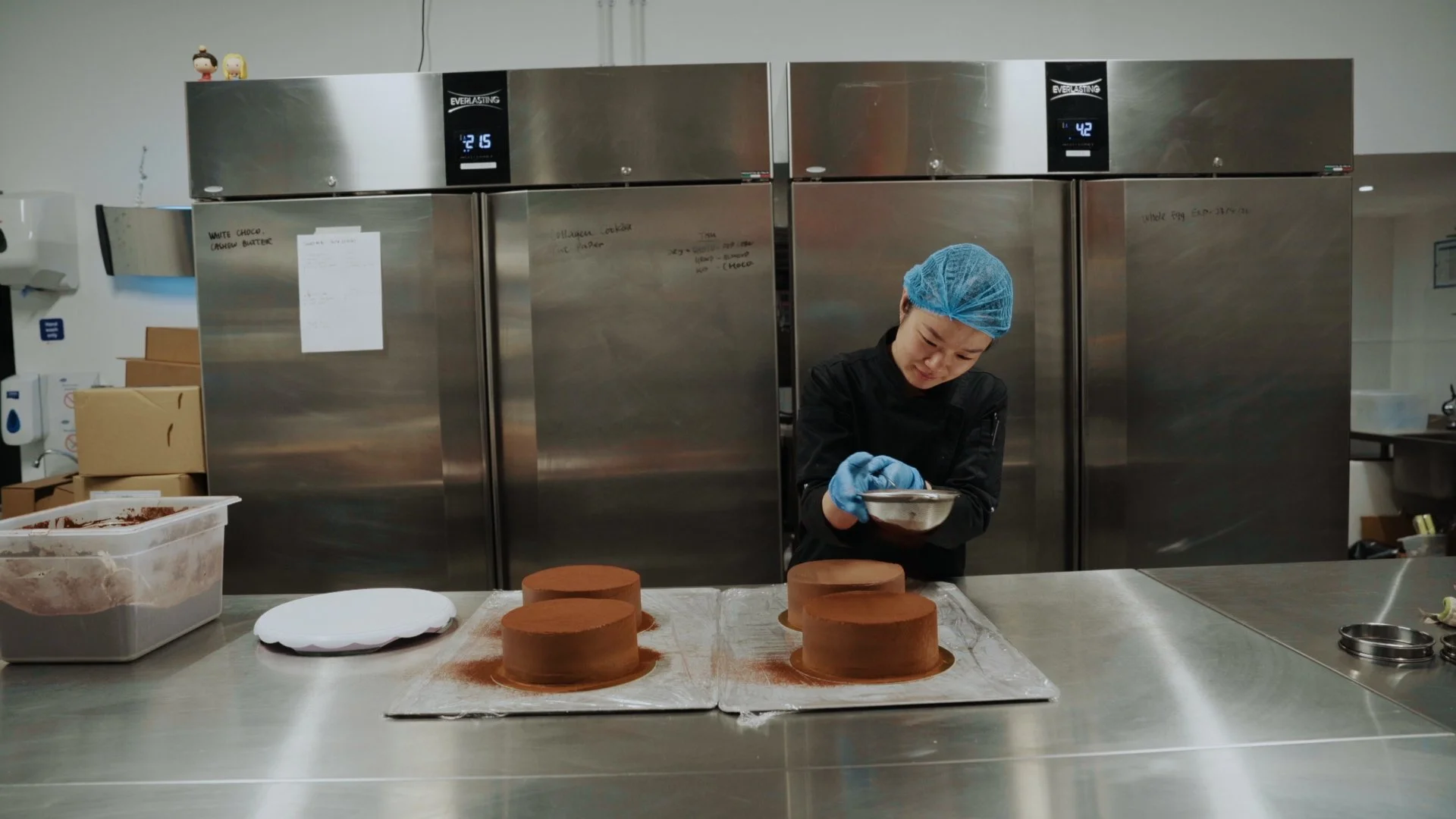
Thankfully, London doesn’t get that hot. Temperature control is not too much of a concern in this kitchen. Alex has made chocolate in four different countries over 18 years: Belgium, France, Canada and China. When they were building the Makers kitchen, the AC and refrigeration systems were some of the first elements that were designed. To prevent condensation, the pastry area was separated from the chocolate area, to keep the fridges further away from the ovens.
Alex gives Noor all the credit for providing him with the business support this project needed, “I do the numbers for the recipes, and she does the actual numbers. Like most chefs, I’m not great with running numbers for a business. I stress a lot and feel quite shy when talking about this part of it all”.
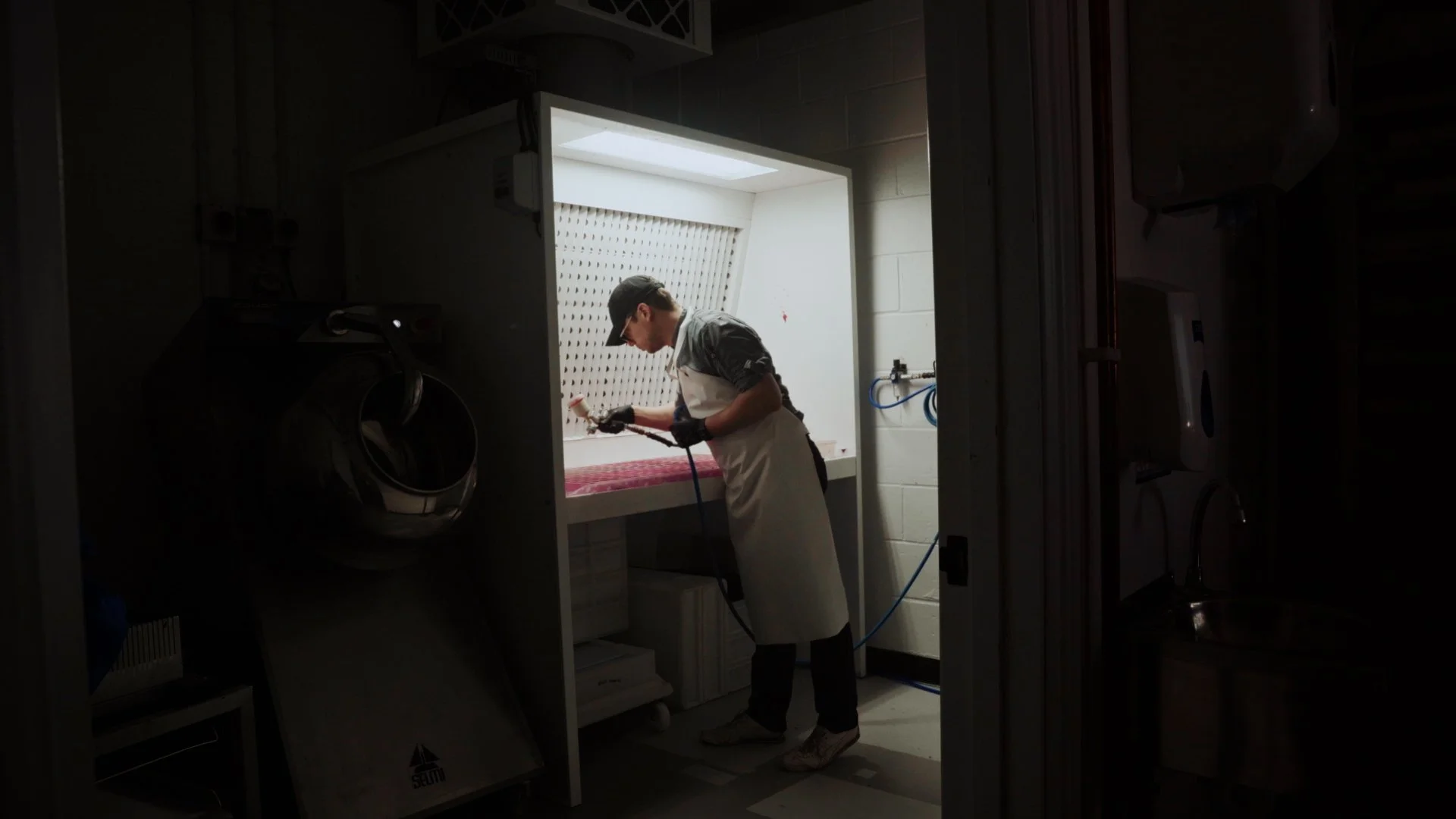
Chef Alex also has a deep appreciation for his team. All of the products featured at Makers are produced by a small team of three; Alex, Corrado and Chloe. Chef Alex shares that finding a good pastry chef, let alone a chocolatier, is like finding a unicorn now, especially after Brexit. That’s why he cherishes Corrado so much, the Italian chocolatier who does the majority of the chocolate production. Alex shares that Chloe also has a genius touch. I learn that she has only started training in pastry four years ago. From her demeanor and ease, you would think that she is a veteran in the kitchen. Now, she’s starting to learn the techniques of chocolate making so that they can have a full rotation of responsibilities.
The size of their team is a restricting element in how much they can realistically produce. Alex knows that it’s too risky to produce over their capacity without the guarantee of sales. He shares that, “for example, the Easter eggs sold out ten days before it was actually Easter. Customers were frustrated. For us to be able to keep it in stock until the last day, we would have needed to double our production and potentially have 30% of it go to waste. In order to cover for that waste, we would also need to make the product 30% more expensive.” Alex believes the right way to manage that is by allowing pre-orders, to gauge demand and plan accordingly.
Before I leave, he tells me to meet the shop team and their manager Thiago. Alex admires them equally as much as he does with the kitchen team, “The relationships the shop team has built with our customers is remarkable. We have returning customers who have been coming from the very beginning - we know everything about them like they do about us. They're such great people. I can always train people to be better in the kitchen, but you can’t really train people to have better interpersonal skills with customers. That comes from within”.