
Home & Away
How Greek Migrants Changed the Way Australia Eats
From the pioneering American-style milk bars of the 1930s to today's restaurants celebrating regional Greek cuisine, a century of food, family and cultural inheritance.
by Madeleine Woon
When the Black & White 4d. Milk Bar, Australia's first modern milk bar, opened for business in Sydney's Martin Place in November 1932, few could have anticipated the frenzy a simple milkshake would unleash. Some 5,000 customers reportedly descended on the shop on its first day, with crowds so large that police were called in to maintain order. The man behind the milkshake mania was Joachim Tavlaridis, a Greek migrant better known as Mick Adams, who had hit upon a rather lucrative combination of American soda parlours, the traditional milk shops of Greece (galaktopoleia) and his own entrepreneurial ingenuity. Armed with a row of electric Hamilton Beach mixers, he began serving flavoured milkshakes, fruit juices and sodas across a long counter for fourpence apiece. There were no cooked meals and barely anywhere to sit. Within five years, the country had some 4,000 milk bars, many operated by Greek migrants.
Among those keen to get in on the action were Stavros and John Coufos, two brothers from the tiny Greek island of Kastellorizo, who opened what is believed to have been Perth's first milk bar in 1935. Their Golden Star borrowed its layout from Adams's Sydney original, helping bring the milk bar craze to Western Australia. Soon, milk bars were springing up across the city, including one on Murray Street that left little doubt about its inspiration: the American Milk Bar. Many were operated by Kastellorizians, whose families had been arriving in Western Australia since the late nineteenth century, making their fortunes, or at least their livings, from oyster saloons, fruit shops, cafés and other small businesses. For an island barely nine square kilometres in size, Kastellorizo had an outsized influence on Australian food culture and, alongside Kythera and Ithaca, was one of the Greek islands whose migrants played a defining role in the country's café trade.
No one has done more to document this extraordinary yet largely overlooked chapter of Australian culinary history than photographer Effy Alexakis and historian Leonard Janiszewski. Partners in life and work, the pair have spent nearly four decades travelling across Australia, photographing cafés, interviewing families and recording the stories of the people behind them. In the late 1980s, they piled into a small Toyota Corolla and set off across the country, tracking down descendants of migrants who had arrived generations earlier. Their research, collected in Greek Cafes & Milk Bars of Australia (2016) and its newly published companion volume, Greek Cafes & Milk Bars of Australia, Vol. 2: People & Place (2026), reveals just how profoundly Greek migrants shaped the country's eating habits and popular culture.
As Alexakis and Janiszewski's research reveals, the Greek café was, in many respects, an unlikely vehicle for American culture, what the pair describe as a “Trojan Horse for Americanisation”. From the 1930s through the 1960s, these family-run establishments became fixtures of Australian towns and suburbs, their interiors expressing what the researchers call “the glamour and allure of America”. The cafés were a riot of Art Deco ornamentation, from flashing neon signs and soda fountains to marble-topped tables and polished wooden booths. Alexakis and Janiszewski describe the experience of stepping inside: “The gurgling and whoosh sound of the soda pump in operation combined with the all-pervading scent of organic essences as their containment bottles were opened to add flavour to the liquid, further intoxicated the senses.”
Menus offered mixed grills, steak and eggs, hamburgers, toasted sandwiches and milkshakes with names like Bootlegger Punch, flavoured with rum essence. Sundaes came as American Beauties, Hollywood Specials and Monterey Specials, while the cafés themselves had equally grandiose names: the Niagara, the California, the Golden Gate.
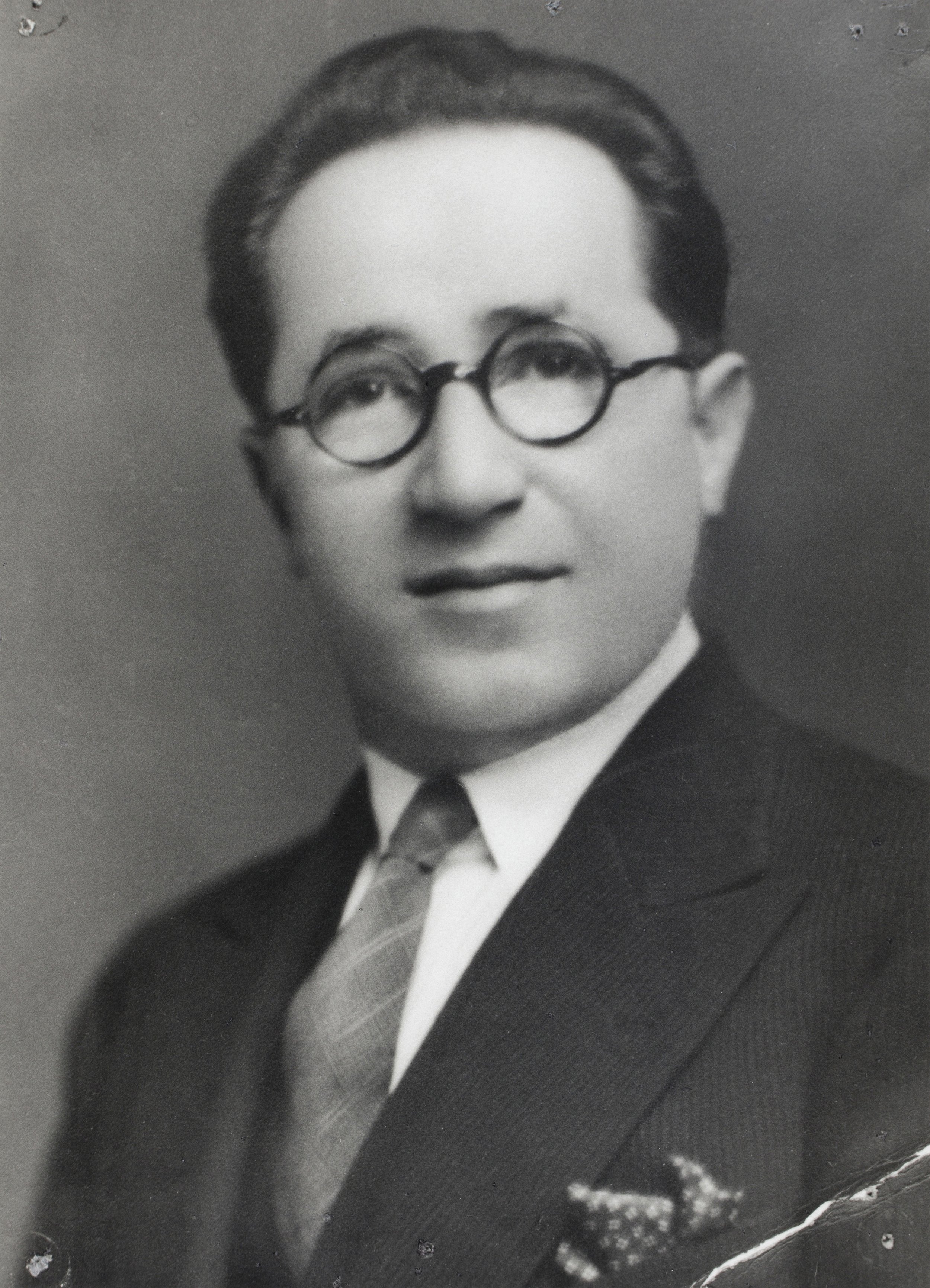
Mick Adams (Joachim Tavlaridis) / Sydney, NSW, late 1920s.
Adams was the creator of the first modern milk bar.
Photo courtesy L. Keldoulis, from the ‘In Their Own Image: Greek-Australians’ National Project Archive
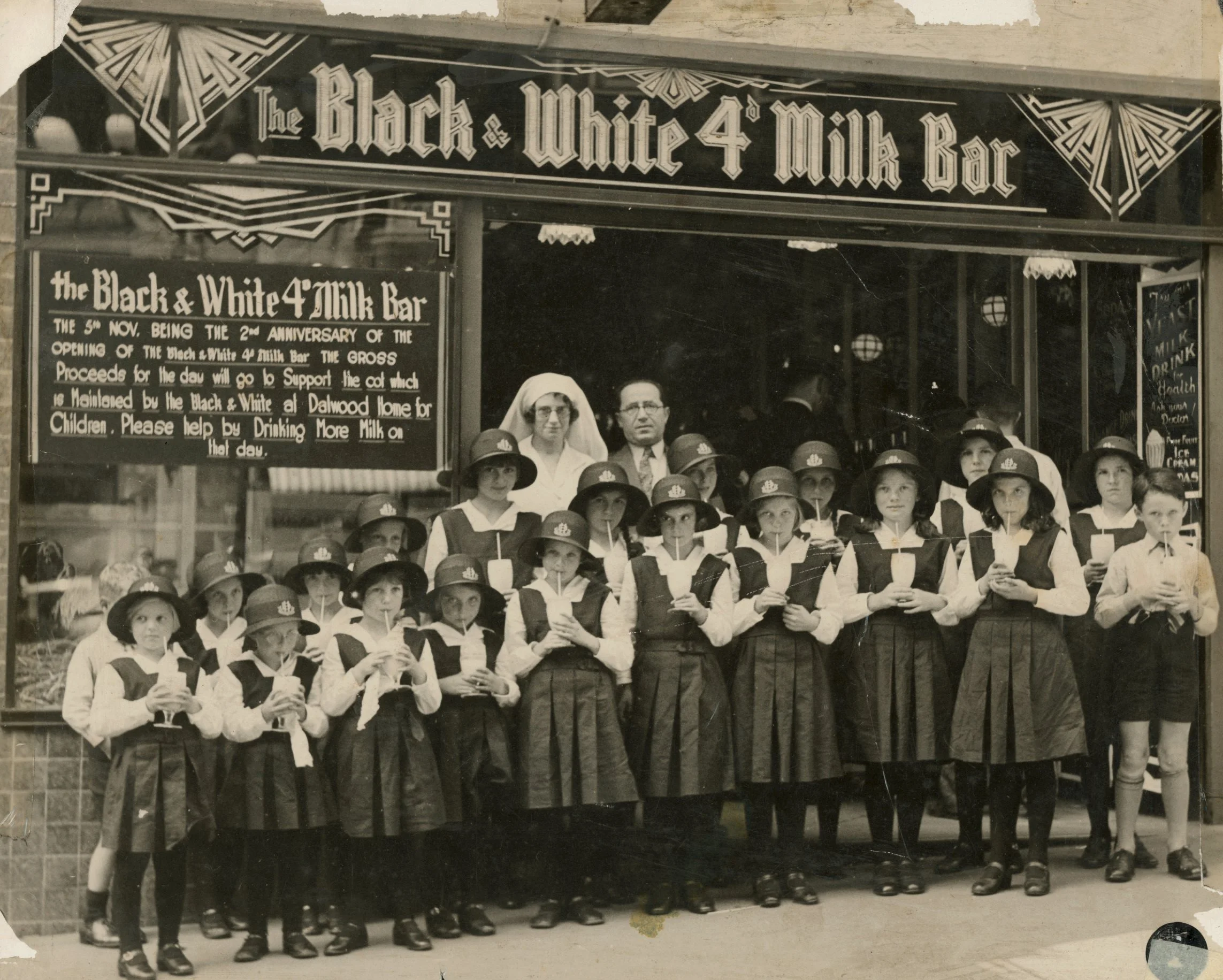
Black & White 4d. Milk Bar / 24 Martin Place, Sydney, NSW, 1934
Mick Adams picture here with children from the Dalwood Health Home.
Photo courtesy L. Keldoulis, from the ‘In Their Own Image: Greek-Australians’ National Project Archive
By the 1950s, the Greek café had become more than a place to eat. In country towns, particularly, it was often the centre of social life, somewhere to meet friends, take a date or meet up before going to the cinema. Teenagers gathered around jukeboxes playing the latest American rock 'n' roll, sometimes well before the music was widely heard on Australian radio. Among the recollections is that of Peter Stratos, who remembered the arrival of the jukebox at Brown's Milk Bar in Perth in the mid-1950s. The music added to a “sense of shared pleasure” he told Alexakis and Janiszewski, drawing “bodgies and widgies” who would linger for hours over thickshakes, sundaes and spider sodas. “They were well and truly hooked!”
“For much of the twentieth century in Australia, soda and sundae parlours, cafés and milk bars, typically run by Greek migrant-settler families, were selling a dream,” Alexakis and Janiszewski say. It was an American dream, expressed through food, architecture, technology, cinema and popular music. In their research, they describe how these establishments introduced Australians to the glamour and possibilities of American popular culture at a time when much of the country remained culturally beholden to Britain.
There was, however, a considerable contradiction at the heart of this American dream. In an Australia still shaped by the White Australia policy and widespread racial prejudice, Greek migrants were introducing the country to American culture while facing considerable pressure to assimilate themselves. Even as their cafés became fixtures of Australian towns, their proprietors were often regarded as outsiders. As Alexakis and Janiszewski explain, offering fashionable American foods alongside familiar British-Australian dishes was a way of attracting customers while “securing commercial appeal and buffering racial antagonism”. The researchers also cite cultural commentator Hsu-Ming Teo, who observes that the decision to introduce “modern American” rather than “traditional Greek” culture says much about the relative safety of American influences for Greek migrants in the age of White Australia.
Novelist Andrew Pippos grew up with the legacy of one such establishment. His grandparents opened Café De-Luxe in Brewarrina, a little town on the banks of the Barwon River in north-western New South Wales, in 1926. Pippos spent much of his childhood there, an experience that would later inspire his debut novel, Lucky's, which follows a Greek-American entrepreneur building a café empire in Australia.
Café De-Luxe had Art Deco fittings, chequered floors and signs declaring the house motto: “Our Motto: Cleanliness and Civility.” Behind the kitchen, Orthodox icons covered the walls of the family's living quarters. Outside, vines and lemon trees grew alongside an enormous olive tree. “If the tree were not real, the metaphor might be too obvious,” Pippos says. “It thrived in the red soil, as did the café itself, which functioned as a restaurant, convenience store, and social hub for the town of Brewarrina.”
For Pippos, who spent every school holiday there until he was seventeen, Café De-Luxe was a second home. Its customers included the town's Anglo-Celtic and Indigenous residents, and his grandmother considered everyone who walked through the door a friend. “It was a place where I felt like I belonged,” he says. “And it was a place where I learned a lot about the world: mainly through the stories I heard at large meals with extended family.”
His grandfather, Angelo, would eventually become mayor of Brewarrina. He had arrived in Australia from the Greek island of Ithaca, sponsored by a fellow islander who operated a café near Sydney's Central Station. After an argument over broken plates, he left the business and eventually found work cutting sugarcane in Queensland. The conditions were punishing, and he resolved to establish something of his own. “My grandfather needed to be respected and highly regarded; he wanted to establish himself and his kin,” Pippos says. Café De-Luxe was followed by other businesses in nearby towns, operated by relatives brought over from Ithaca.
For Greek migrants, hospitality offered a relatively accessible route to economic independence. Alexakis and Janiszewski trace the origins of Greek food businesses in Australia to the nineteenth-century gold rushes, when enterprising migrants recognised that supplying miners with food promised a more reliable income than prospecting themselves. Their success encouraged others to follow, establishing networks of migration and employment that would continue for generations. But the food these families sold was rarely the food they ate.
“The café Greeks understood that they had to cater to Australian tastes if their businesses were going to succeed,” Pippos says. “If the business failed, they stood to lose not just their livelihood but their home.”
At Café De-Luxe, the distinction was literal. Different sides of a large wood-fired stove were used to prepare the mixed grills and other familiar dishes served to customers, and the Greek food the family cooked for themselves. “[My family] were professional cooks so they had a natural need to cook the food they knew best, which was Greek food, especially the food of the Ionian islands,” Pippos says. “The people from that region of Greece are rightly proud of their food. Even a very small island like Ithaka has unique traditions, like cooking with a tserepa, or with the local herb sapsicho.”
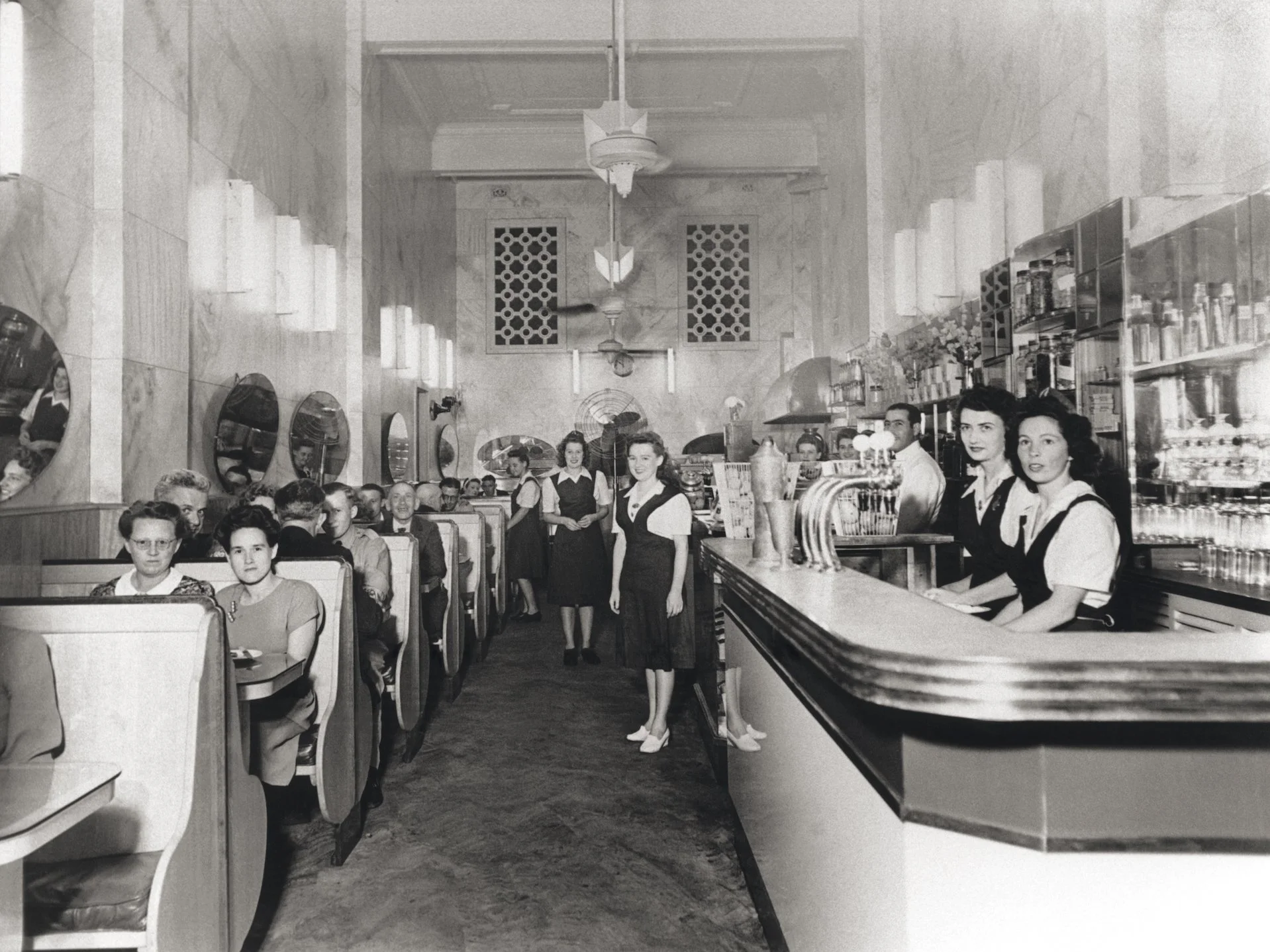
Astoria Café Hunter Street, Newcastle, NSW, late 1940s (Photo courtesy N. Raftos, from the ‘In Their Own Image: Greek-Australians’ National Project Archive)
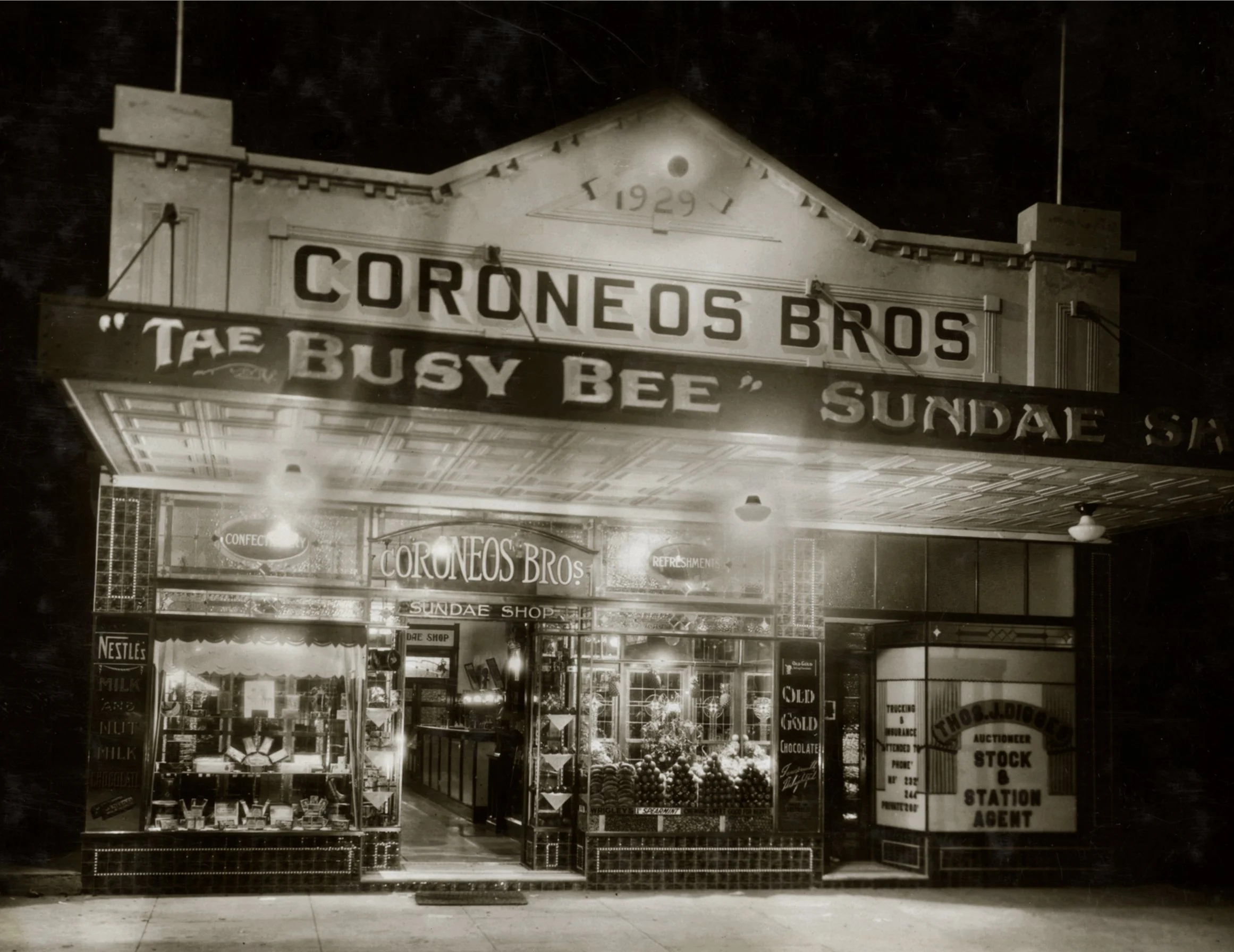
Coroneos Bros. The Busy Bee Sundae Shop / Castlereagh Street, Coonamble, NSW, mid-1930s (Photo courtesy S. Siafarikas, from the ‘In Their Own Image: Greek-Australians’ National Project Archive)
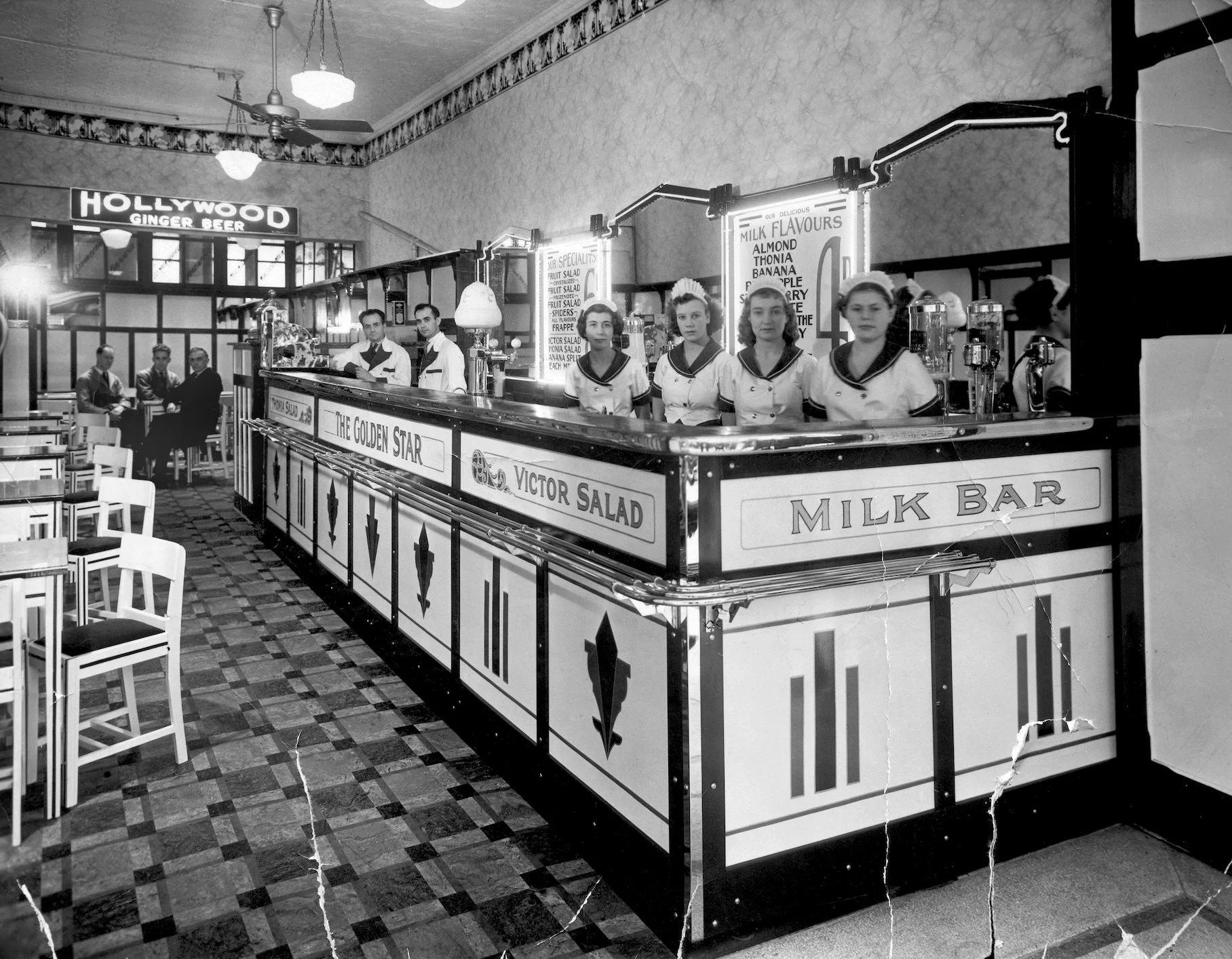
The Golden Star Milk Bar / Hay Street, Perth, WA, mid-1930s The Golden Star appears to be Perth’s first milk bar. It was established by brothers Stavros (on left behind the service counter) and John Coufos, originally from Kastellorizo. (Photo courtesy M. Coufos, from the ‘In Their Own Image: Greek-Australians’ National Project Archive)
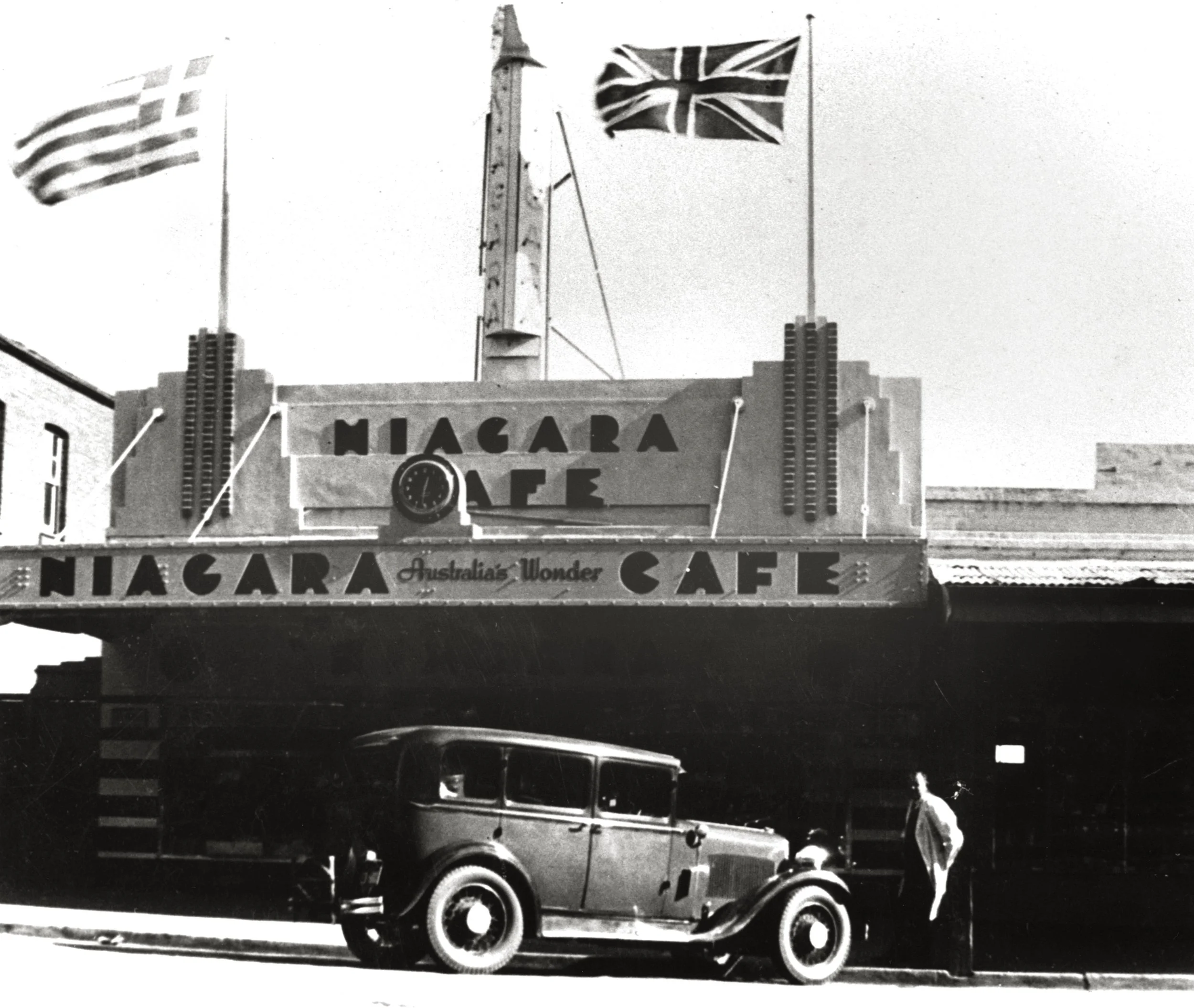
Niagara Café, ‘Australia’s Wonder Café’ / 142 Sheridan Street, Gundagai, NSW, c. 1938 (Photo courtesy J. Castrission, from the ‘In Their Own Image: Greek-Australians’ National Project Archive)
It was a distinction repeated in kitchens across the country. While customers ordered hamburgers, mixed grills and American Beauty sundaes, the families behind the counter were eating moussaka, lemon-roasted lamb, bean soup, stuffed eggplants and stifado. Preserving these culinary traditions often required considerable ingenuity. Olive oil, now a fixture of Australian kitchens, was once so unfamiliar that it had to be bought from the chemist. In country towns, Greek women gathered dandelion greens to prepare as horta. Alexakis and Janiszewski discovered through their interviews with Greek-Australian families that migrants also brought seeds for eggplant, okra, artichokes, oregano and basil from Greece, sometimes illegally, alongside vine cuttings and olive seedlings.
The cafés themselves, meanwhile, placed considerable demands on the families who ran them. Alexakis knows this firsthand. Her parents migrated to Australia in the 1950s and initially worked in factories, before her father suffered an accident that made physical labour difficult. Hoping for greater independence, they opened a fish-and-chip shop in Sydney. “Those early years were difficult as my sister and I were expected to work in the shop with our parents, especially during busy times,” she says. “The shop was in an area that did not have many other Greeks so my sister and I would feel uncomfortable serving people and found it embarrassing growing up, we would hide at the back of the shop if we saw school kids that we recognised!”
The testimonies collected by Alexakis and Janiszewski reveal just how isolating life behind the counter could be, particularly for women who had migrated to small country towns. Maria Georgiadis, who worked alongside her husband at Tamworth's Fitzroy Milk Bar from 1962, recalled: “I had no relatives, no friends [Greek or British-Australian]. I couldn't speak [English] much ... we didn't have the same opportunities like the big cities. We didn't go anywhere together, the shop was always open.”
For Alexakis, documenting these experiences became a personal mission. She had begun photographing her own family while studying photography, but her father's unexpected death at fifty-five strengthened her determination to record the lives of Greek Australians whose contributions had been largely overlooked. “Our initial focus was to break down existing stereotypes,” she says. “The main one being a folkloric stereotype – whenever you looked in the media a Greek person was usually wearing their national costume or they were a shop owner – yes, they did do these things, but it was part of a larger picture.”
One of the most affecting stories the pair encountered was that of Maria Kosseris, who survived the 1943 Kalavryta massacre, in which German soldiers killed hundreds of men and boys, including her father. She later migrated to Australia and helped her husband run the White Rose Café in Binalong. When Alexakis and Janiszewski visited, they sat with Maria in the kitchen behind the café, recording her account of searching among the bodies for her father, while their young daughter played outside.
“We were moved and overwhelmed by the clarity and the expression of her experiences,” they recall. The pair continued visiting Maria over the years, and when she died in 2021, her family chose one of Alexakis's photographs for her memorial card.
By the 1970s and 1980s, the Greek café was disappearing from Australian towns. Television, supermarkets, fast-food chains and highway bypasses had transformed the way Australians ate and socialised. Yet their decline was also a measure of their success: the children and grandchildren of café proprietors were increasingly pursuing university educations and professional careers, often with their parents' encouragement.
“My grandparents built a café and worked hours that were punishing by anyone's estimation; my father escaped a career in hospitality; and I inherited enough freedom to pursue the ambition of becoming a novelist,” Pippos says. “The Café De-Luxe made possible a life utterly unlike the one my grandparents led.” The café remained in the Pippos family for more than eight decades before burning down in 2014, a loss he describes as “like losing the family castle”.
As the cafés disappeared, the Greek food once confined to their proprietors' homes was finding a wider audience. By the 1980s, olive oil and feta were appearing on supermarket shelves, while Greek restaurants were serving dishes earlier generations hadn't felt able to put on their menus.
For Perth restaurateur Despina Tanner, hospitality ran in the family. Her father, John Kominos Kannis, arrived in Western Australia from Kastellorizo in 1946 and established himself as a tailor on Rokeby Road in Subiaco, where several of his relatives were already running food businesses. Her aunt and uncle ran the London Fish Supply, her uncle walking several kilometres to the West Perth markets for fresh seafood. Newly arrived relatives lived in the rooms above the shop, while others opened fish-and-chip shops and delicatessens in the neighbourhood.
Yet Tanner's childhood memories of food centre on family gatherings rather than restaurants. “When we were growing up, we never went out to restaurants,” she says. “It was always big family gatherings at home, and always aunties, everyone making a plate, and picnics.”
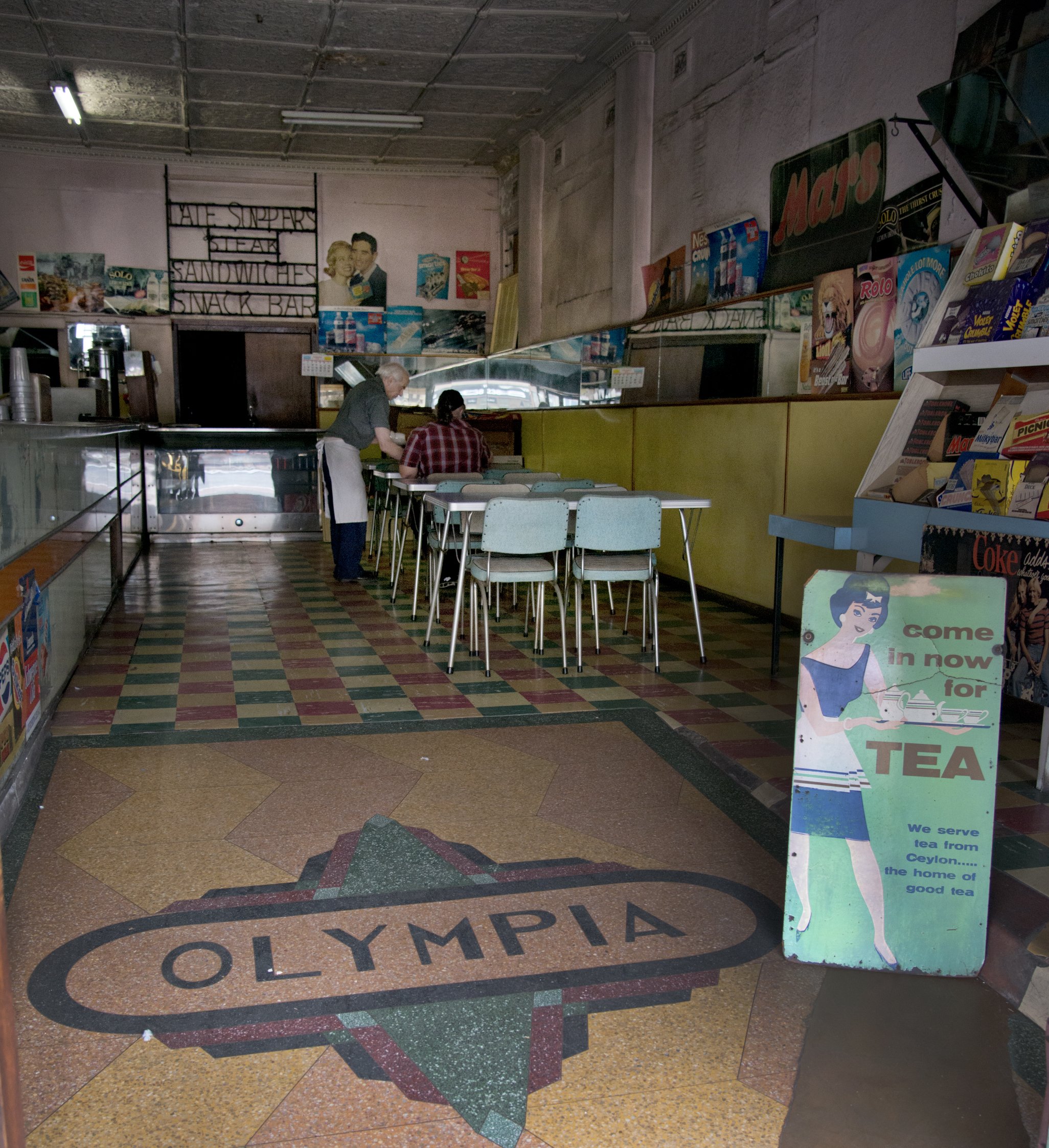
Olympia Milk Bar / 190 Parramatta Road, Stanmore, Sydney, NSW, 2015
Photo by Effy Alexakis
In the 1980s, Tanner and her husband, Brian, transformed a rundown deli in Cottesloe into John Street Café, scraping cigarette advertising from the windows, painting the interiors white and opening up the courtyard. Among Perth's early proponents of alfresco dining, they brought a European sensibility to the city's emerging café culture, with counters laden with homemade cakes, pastries and fresh salads.
Decades later, Tanner returned to Rokeby Road to open Boucla, one of Perth's best-loved neighbourhood cafés. Moroccan textiles, colourful ceramics and photographs of her Kastellorizian ancestors filled the interiors, while her chocolate ricotta cake and pistachio-topped soufra developed something of a cult following, inspiring countless imitators and attracting everyone from local regulars to Mick Jagger. “I was so happy when I had my little shop because I could create,” Tanner says. “I could choose every day to be happy in my own space, you know, and create a world in there for people to just escape to.”
The couple's next venture, Lady of Ro, was a Mediterranean restaurant named after Despina Achladiotou, the Kastellorizian woman who lived alone on the neighbouring island of Ro following her husband's death, raising the Greek flag each day and eventually becoming a national heroine. With Brian cooking in the open kitchen, Tanner preparing salads and desserts and their son John, an architect, designing the interiors, it was another family affair.
Kastellorizo remained a powerful presence in Tanner's life. In 1973, aged twelve, she accompanied her father on his first visit to the island since emigrating. Arriving by boat from Rhodes in the middle of the night, she watched him step ashore, make the sign of the cross and kiss the ground. In 2018, after decades running hospitality businesses in Perth, she and Brian moved permanently to Kastellorizo. These days, she harvests wild capers, almonds and olives, cooks for a seemingly endless procession of visiting friends and family, and enjoys the sort of hospitality that first inspired her, this time without a restaurant to run.
For a younger generation of Greek Australians, those same traditions have become something to rediscover. Melbourne-based chef and writer Ella Mittas grew up eating a familiar rotation of Greek dishes in her family's Brunswick home: moussaka, gemista, pastitsio and leek pita. Her grandparents had migrated from a mountain village near Thessaloniki, her grandfather arriving in Melbourne at eighteen and later sending for her grandmother, who was just sixteen. It was only much later that Mittas discovered her yiayia, whose cooking had seemed such an immutable part of the family's Greek identity, had barely known how to cook before leaving Greece. Many of the dishes she came to regard as her grandmother's specialities had been learned in Australia, reconstructed from family memories and whatever ingredients were available.
Mittas has since spent considerable time cooking and traveling through Greece and Turkey, experiences that informed her first cookbook, Ela! Ela! To Turkey and Greece, a Journey Home Through Food (2024). Her second, Ela! Ela! To Italy, Georgia, Bulgaria and Home (2026), ventures further afield, exploring the culinary traditions that survive migration and the ways in which food preserves cultural identity. “I had always imagined I was a lot closer to Greek culture when I was in Australia,” she says. “Then, when I lived in both Greece and Turkey, I realised how many of my approaches to things were shaped by growing up in Australia.”
Her father's experience had been quite different. Having encountered racism growing up in Melbourne, he made a conscious effort to appear more Australian, devoting much of his time to the Australian Football League. Mittas, who experienced no such discrimination, felt considerably freer to explore her Greek identity.
While Greek food has become a celebrated part of Australia's culinary landscape, much of the country's regional diversity remains relatively unexplored. The familiar repertoire of taverna classics tells only a fraction of the story. Greek cooking varies enormously between its islands and mainland, shaped by geography, climate and agricultural traditions. Mittas points to wild greens as one example. “Outside of the main summer green vlita, there are very specific and regional greens that get served all over Greece,” she says. “They are a prized ingredient, and I think we can learn a lot about eating seasonally from the way the Greeks handle their greens.”
It's a culinary breadth that Pippos would like to see better represented on Australian menus. “Greek cuisine is very regional, and I wish that diversity was explored a lot more,” he says. “If you can't go to Greece on a whim, and you want to experience a variety of regional dishes, then you need to eat in people's homes, where they cook the family favourites. So a lot of great Greek food is still cooked in private.”
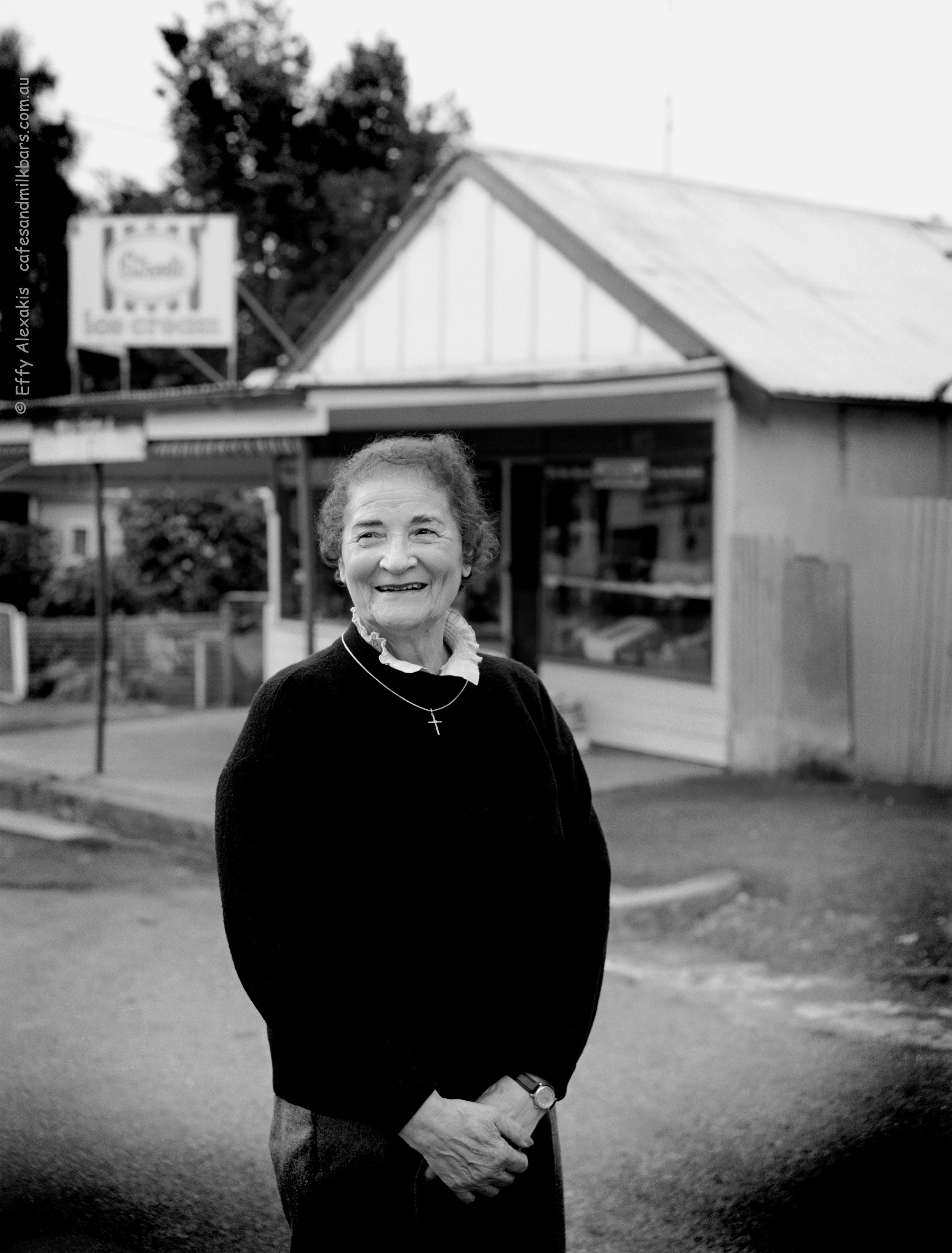
Maria Kosseris (née Stathouia) outside the White Rose Café Fitzroy Street, Binalong, NSW, 2002 (Photo by Effy Alexakis)
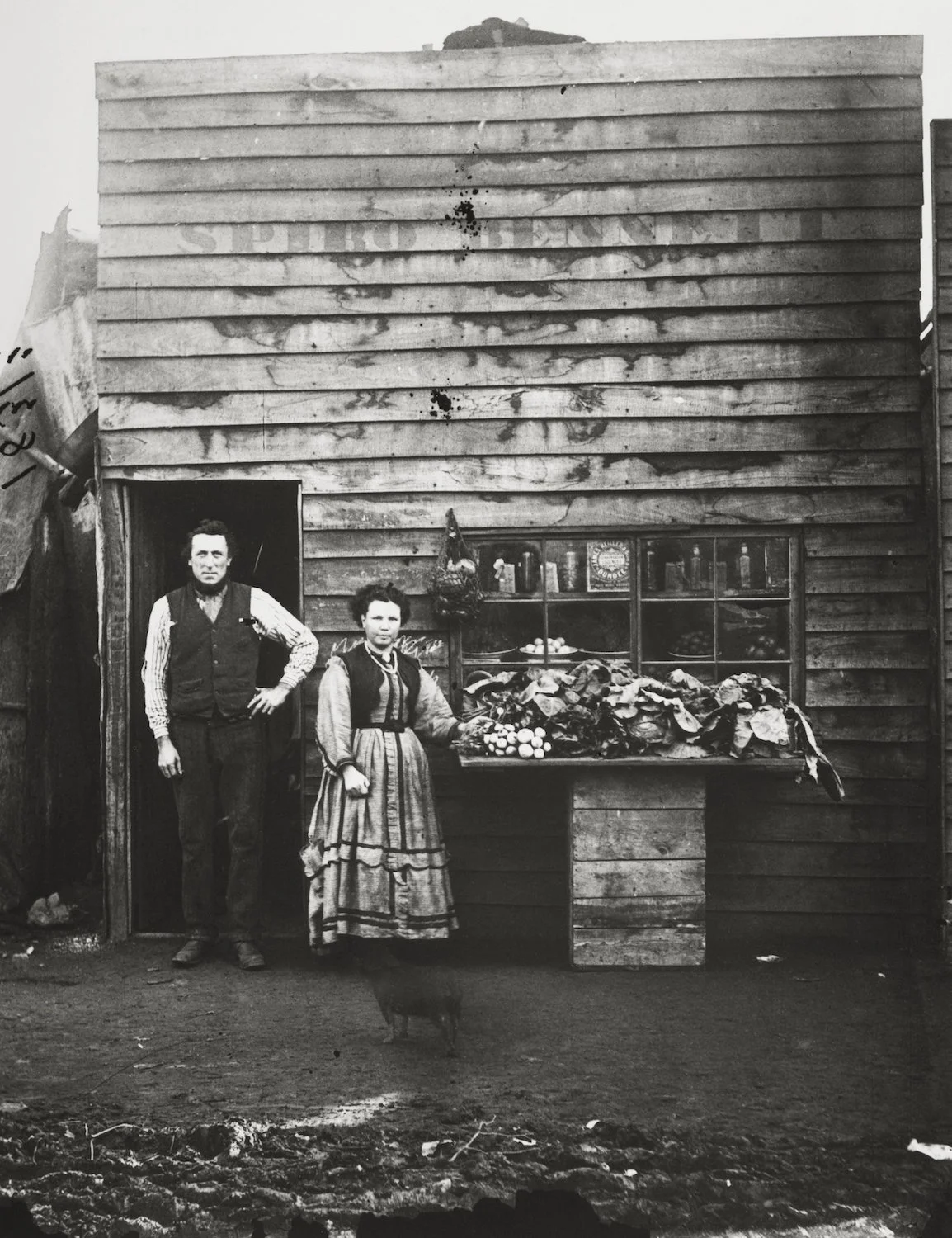
Spiro Bennett and his wife, Ann Jane (née Caroll) outside their store at Mayne Street, Gulgong, NSW, 1870s Noticeable Greek involvement in the Australian food trade – retailing and catering –commenced during the gold rushes of the 1850s to the 1890s. Spiro Bennett was one of several gold rush Greek settlers who engaged in food retailing. Like so many of his countrymen during the Australian gold rushes, Spiro appears to have anglicised his surname, or adopted a new one, to ensure easier acceptance into the host culture. Traders and storekeepers were needed to supply food and goods to the mining population on the goldfields. The fresh vegetables displayed outside his store window probably came from his own market garden. (Photo courtesy Holtermann Collection, Mitchell Library, State Library of NSW)
Today, a growing number of Greek-Australian chefs are drawing on the regional cooking traditions of their families. In Melbourne, the menu at Con Christopoulos and Stavros Konis's Kafeneion includes some of Greece's less familiar dishes, from magiritsa and fried sweetbreads to slow-cooked lamb with wild oregano. For Konis, hospitality runs in the family: his grandfather and father ran Salona in Richmond, serving lamb's head and offal to Melbourne's Greek community. Across town, Angie Giannakodakis's Taverna follows the seasons, with artichokes, peas and eggplants appearing alongside dishes from her mother's repertoire, including moussaka.
Jonathan Barthelmess opened The Apollo with Sam Christie in 2012, offering a contemporary take on Greek dining. His newer restaurant, Olympus Dining, takes its cues from the garden tavernas and mountain villages of Greece, with dishes such as kokoretsi, wild-greens spanakopita and prawns with trahana. At Olympic Meats in Sydney, Timothy Cassimatis turns to the cooking of his grandparents, whose families came from Kythera and the Peloponnese, making spanakopita with hand-stretched filo and pastó, a preserved pork speciality they taught him to prepare.
For Mittas, these questions of cultural inheritance have recently taken on a more personal dimension. With her son now six months old, they're making their first trip to Greece as a family. She hopes he'll develop his own connection to his heritage. “I want him to have access to as much of life as possible and would love for him to have a connection to Greek culture, as it has given me so much.”