
Through the Olive Groves of
Palestine
Text by Ebru Eltemur
Photography courtesy of Ya Albi and Yasmeen Abouremeleh
In places like Palestine, artisans depend on their work for survival. The conditions in which they live force them to rely on craft as a means of endurance. This year was not the first year that Palestinian farmers were asked to abandon their olive groves. The attack on their land has been used as a weapon of oppression for over seven decades. The preservation of their profession depends on generational knowledge. The only difference between then and now, is how much the public is exposed to this reality. Despite the political challenges, there are people in the diaspora who are taking action to change this narrative of erasure, and Yasmeen Abouremeleh is one of them.
Yasmeen started Ya Albi after experiencing a bout of helplessness. Her exit from her fashion job was followed shortly by the October 2023 attacks and the escalation of the war on Palestine, and she returned to San Francisco to spend time with her family. Living in Los Angeles at the time felt like living in an alternate reality. “I couldn’t be around people who weren’t thinking about the same things as me and it was driving me crazy,” she explains, “I felt that I needed to do something to try to help everyone in Palestine, including my own family”. Her mother suggested that they do an olive oil-based project, a suggestion that felt very fitting. Until then, Yasmeen could never be sure about the right moment to talk about her Palestinian identity. “There’s a lot that comes with it because people have assumptions, and they expect you to explain yourself in a very particular way”, she adds. Since the launch, Yasmeen has been involved in every step of the process of Building Ya Albi. She handles the design, manages inventory, packs and ships everything herself with occasional help from her family.
Growing up in the Bay Area, Yasmeen wasn’t fully privy to the larger Palestinian community. Only after moving to Los Angeles did she begin to grasp its scale. Her childhood was spent with Muslim neighbors, especially in celebration during the holidays. Her understanding changed once she had another experience to compare it to: “When I went back to San Francisco for the first time after a while, I realized that every other corner shop is owned by a Palestinian.” Palestine was never a distant destination for her because of her family’s yearly travels.
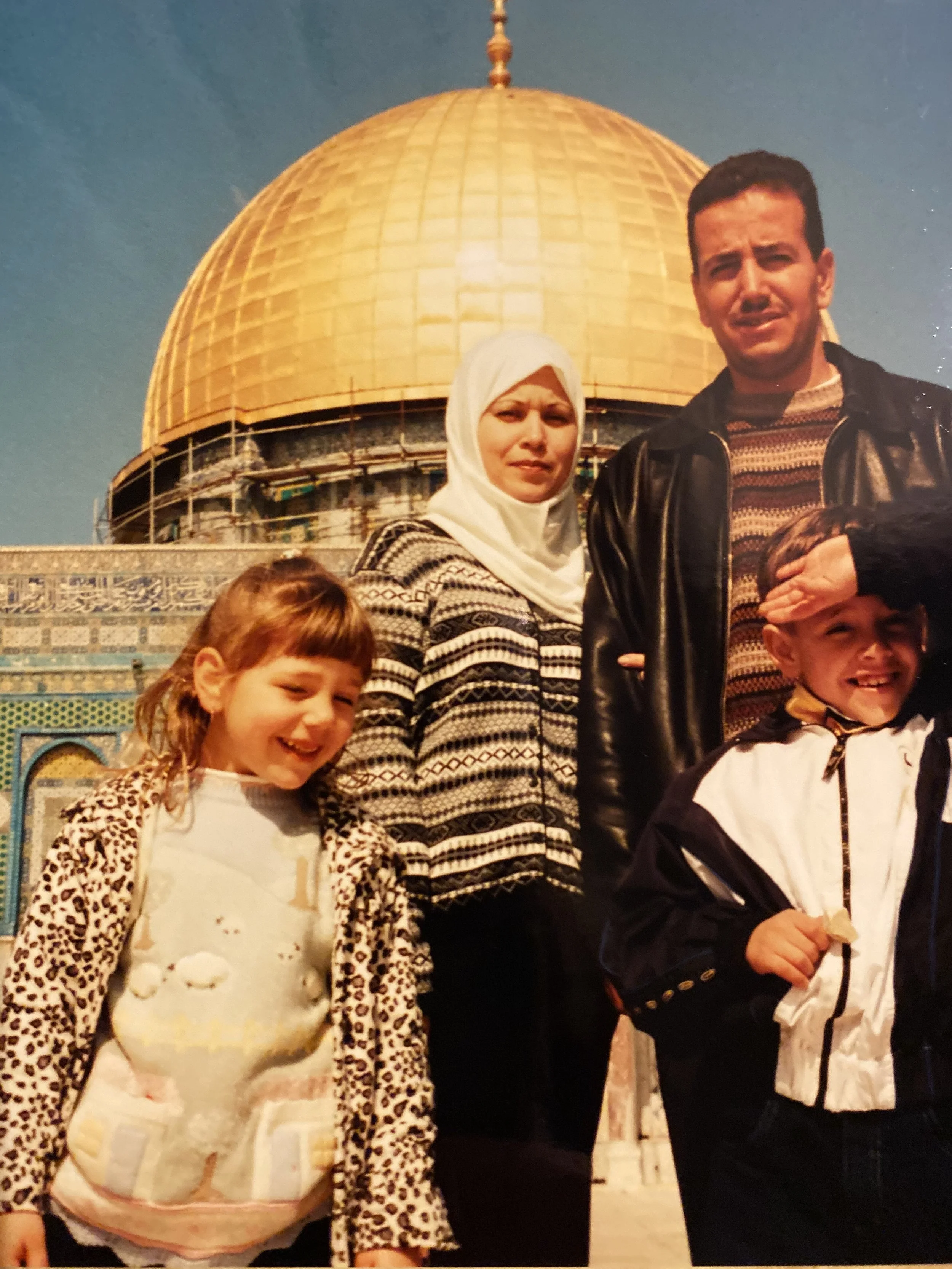
Yasmeen and her family in Palestine
Olive oil has always been an important part of her life, like most Palestinians. According to the Palestine Farmer Union, a quarter to a third of the West Bank’s population relies on olive oil production as their main source of income. 70% of their harvest was threatened in 2025 by settlers and military. “Olive oil is tied to something much bigger than food. I was raised with the belief that the land belongs to those who cared for it,” Yasmeen explains. Naturally, olive trees are everywhere in Palestine, but so many of them have been lost to warfare and ecocide. Due to its availability, Palestinians consume olive oil for many purposes besides cooking. Yasmeen’s grandmother used to rub it on her stomach for stomach aches or on her temples for headaches. She says she “viewed it as the solution to everything, not just an ingredient.” Her paternal grandmother, who still lives in Palestine, first saw Ya Albi in person when her parents brought her tins last winter.
While the product is sourced from the West Bank, it is bottled in California. Importing packaged goods directly from Palestine can become very complicated, especially with labelling restrictions. Yasmeen shares that some new regulations include the mandatory replacement of “Palestine” with “”West Bank”, the banning of flags and symbols representing Palestine on packaging and sizing restrictions. This does not come as a surprise. In January 2023, the Israeli government banned the flying of Palestinian flags in public spaces. In response, Palestinians found other ways to represent their nationality using symbols like olives and watermelons, which have become universally popular on social media.
The problems with exporting from Palestine don’t end with the product — they also seep into the logistics. All trucks carrying Palestinian goods get stopped at checkpoints between cities if, by chance, they are not asked to turn around. On occasion, checkpoints can be closed and drivers have to find another route to get to the next one, which may take hours. If the officers at the checkpoint deem it necessary, the pallets on the truck have to be unloaded and reloaded onto a different vehicle. There are two ports that Ya Albi can leave from, but Israeli officials always determine how long it will take for it to clear customs. As long as the product stays at the port, you must also pay for the storage. “Nothing about the process is smooth,” Yasmeen adds, “you’re constantly adjusting because something will go wrong and you have to expect that it will go wrong. The reason our pricing cannot stay stable is because we don't have a normal supply chain. Even if it were so, with the war on Iran, the price would continue to go up.”
The farmers that Yasmeen sources Ya Albi from are now part of her extended family in Palestine. When she first started the company, they weren’t chosen at random. The pool was already small to work with and it’s getting tighter over time. Yasmeen emphasizes how problematic last year was: “I’m working on maintaining those relationships because last year was a very difficult year for the farmers. It was a very small yield and the taxes on olive oil were almost doubled, which is also tough on me as a small business owner. I needed double the amount of product I got, but instead it was the price that had to be doubled.” There are middle men between Yasmeen and her suppliers, who deal with the bureaucracy of getting the olive oil across the ocean. “The farmers don’t have the mental or physical capacity to deal with the impossible logistics and I can’t do much either because I’m not on the ground,” she notes.
The olive trees in Palestine are older than most communities in the region. They have outlived different civilizations. When they are uprooted, entire histories are erased. For Yasmeen, what the rest of the world has been seeing on the news, is unfortunately not news. In recent months, she has had to watch her own family’s land get burned while on Facetime. This technique of destruction has been used for decades, particularly because Palestinians are so economically dependent on olive trees. When she started her business, she was aware of the risks that come with an unreliable supply chain. Last year was a low yield year for a number of reasons for Ya Albi’s farmers, one of them being the natural cycle. From what Yasmeen has learnt, a good year of harvest is usually followed by a bad year of yields because nature needs time to renew. However, man-made factors are also key determinants in harvest quality. Yasmeen explains that the detritus from the war has changed the environmental conditions, directly affecting the health of the olive trees. On top of the environmental impact, farmers are psychologically and physically threatened by settlers. The existence of Ya Albi, in and of itself, is a form of resistance.
Survivor’s guilt, as some call it, has also played a big part in Yasmeen’s journey. Her father left Palestine for his own safety when he was young. Her mother, who was born in the United States, grew up navigating similar, if not more complex, feelings as a Palestinian woman. Since childhood, Yasmeen has experienced freedoms a majority of her family has never had. “I know I cannot live like this,” she says, “The decisions my parents made gave me a better life, and I will be forever grateful for that. Every day I am reminded that this grief and guilt will never go away, but I need to learn to live with it. I have only just started to accept that.”
That a global awakening of this scale could only come from the exposure of a genocidal war is a devastating reality. For Palestinian victims of war, the incidents that are amplified on social media are not exceptional. The tragedy of the war on Palestine is a cumulative result of decades of political strategy, but media coverage is not reflective of that. In most instances, this dissociation makes Palestinians who live in the diaspora feel more isolated. Yasmeen tries to see the positive in the power of social media in this context, “It feels weird to say this, but I feel grateful that people even know where Palestine is now. Growing up, saying I was Palestinian often felt like a controversial statement rather than simply sharing where my family was from. I felt like I had to explain my identity before people could understand it.”
Although misinformation is plenty on larger media platforms, social media has allowed for people to share their first hand experiences and reality. With journalists being unable to enter Palestine or even speak on the issue, the world has come to rely on the Palestinian people for real information.
“This issue has become a litmus test for basic human morals,” Yasmeen says. “Are you my friend or not?” Having opportunities to tell her own story and provide a Palestinian American perspective has been part of her self-realization through Ya Albi. Since 2024, major journalistic outlets, including The New York Times, have adjusted their coverage in response to criticism from audiences. This raises the question of whether news can ever be truly “objective” or whether it is inevitably shaped by the demands and criticisms of its consumers. Needless to say, it is never too late to be on the right side of history.
Creating Ya Albi was a tangible way for Yasmeen to not only help, but also to turn the grief she was holding into something creative. “When you can channel those very strong feelings into something beautiful, the end result is more meaningful. I think a lot of people can see that in Ya Albi.” From Yasmeen’s face, it is easy to tell that those feelings are still very much present. “I still have hard days and I still have this little cloud over me. There are days where I really need to let it out, but I can't imagine what I would be feeling if I didn't do something about it”. Yasmeen wants Palestinians to feel pride in Ya Albi just as much as she does. She also wants other people to feel connected to something bigger. The future for Ya Albi doesn’t stop with olive oil. Depending on the developments in her supply chain, Yasmeen hopes to expand into importing other products from the region, including dates. As global awareness of the Palestinian struggle deepens, Ya Albi will grow with it—carrying its stories and memories to new audiences.