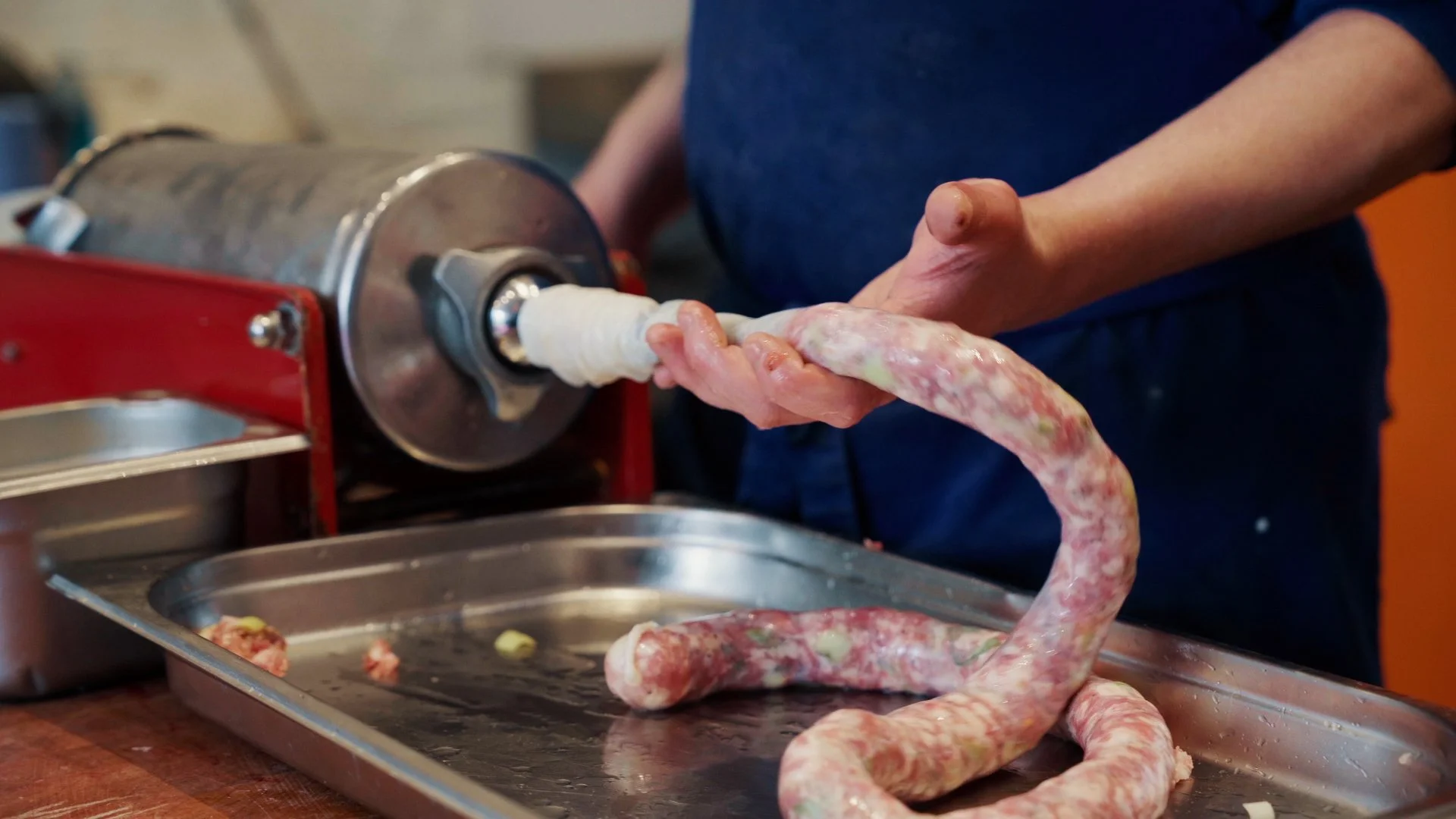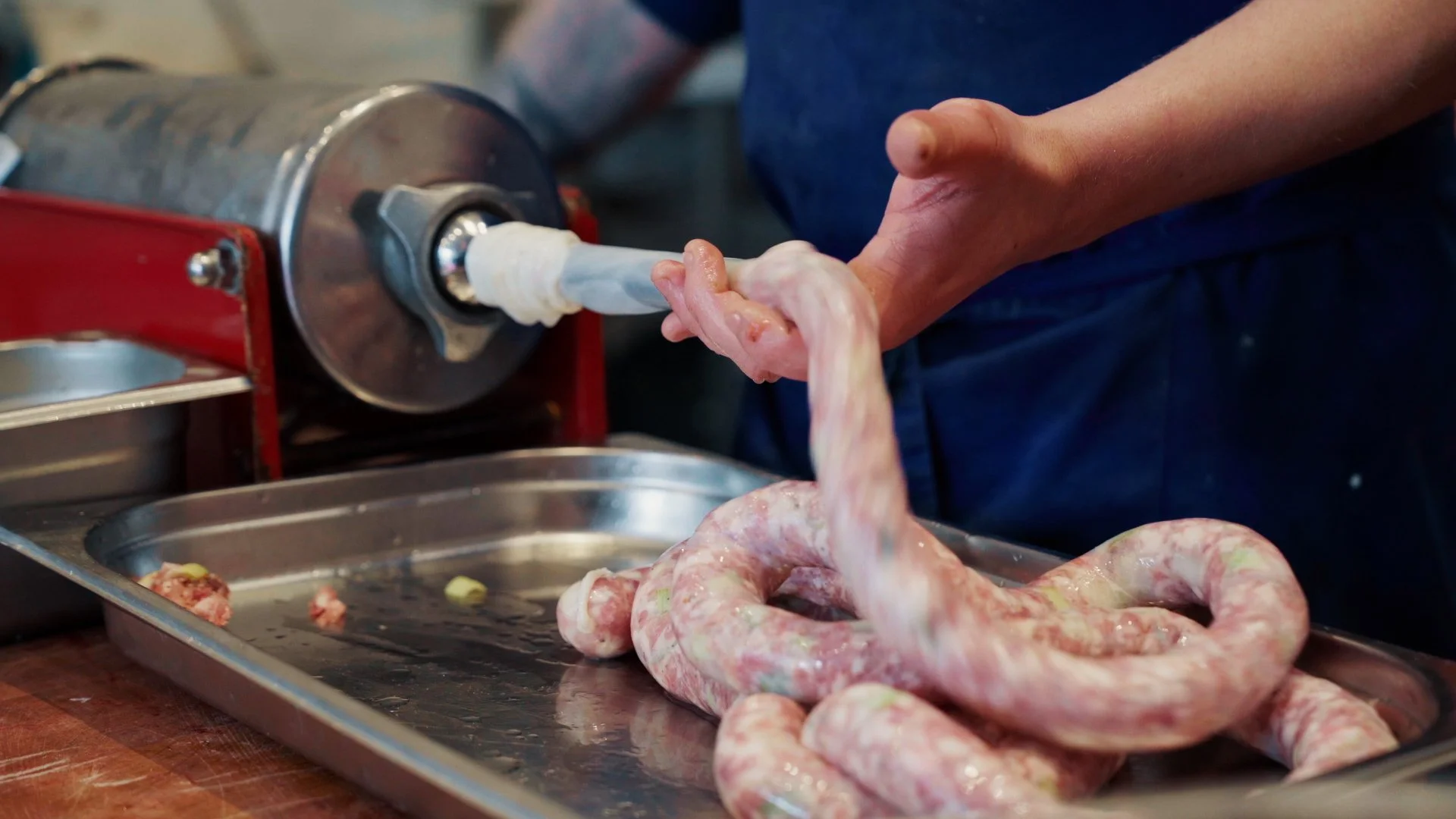
Tasty Links on Lamb Street
— Perry's Butchers
It’s 8:30 am and Spitalfields is still sleeping. The market is silent but the coffee stall is brewing the first batch of the day, while others are already starting to prepare for the lunch rush.
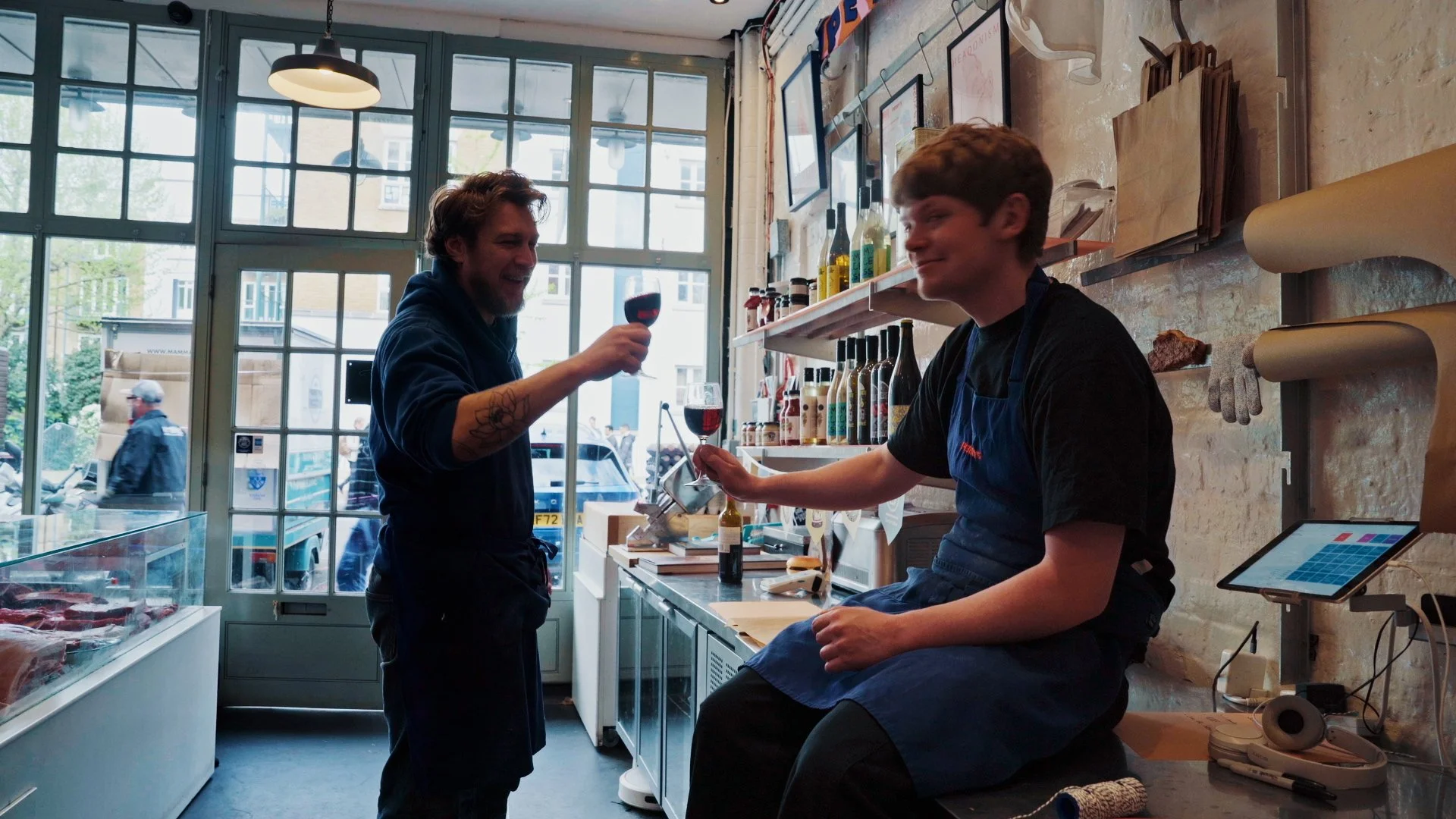
Perry meets us bright and early to greet his delivery men, who will be bringing the meats he ordered to the shop. The delivery is late, which happens frequently, he says, so we head right in. Around 9.45 am, Harvey, the only other employee, rolls in to help prepare the shop for the day. They catch up over movies they’ve seen over the weekend while sharpening their knives. Perry rips a layer of fat from a big cut of pork with his hands before trimming it with his tools, and Harvey starts cutting up the sausages they’ve aged in the walk-in.
As they start filling up the window, Perry walks us through each type of sausage they make in house: Cumberland, Toulouse, chorizo, chipolata, mac and cheese, fennel and merguez. Across from the vitrine, there’s a counter full of jarred and pickled goods lined up for purchase. Underneath are the cookbooks and reference books. Amongst them is Pat LaFrieda’s “Meat”. I’m surprised to see Pat’s book in a small butchershop in East London, but Perry tells me that “everyone knows Pat LaFrieda.” He references the book for Pat’s smoked meat recipes and special techniques. We ease into our conversation when I ask him about how he got a start in the industry.
Text by Ebru Eltemur
How did you get into this at 17? What was the impulse at that age?
I left school at 16 and didn't really know what to do. I was still living at home and my mum told me I needed to have a job, some responsibility. At the time she worked at the Smithfield Meat Market. They wanted a young man to come in and basically just run around. So I started there, literally hit 17. I remember my first day thinking, what is this about? But I ended up kind of falling in love with it, and the sort of the camaraderie down there and not having to have this massive education. What you put in, you got out of it. It's so experience-based. As time went on, I learned more, grew, started interacting with customers and then sort of just progressed from there. It was definitely a transition, but for me, there was nothing else like it. I really enjoyed it.
How have your mentors and teachers shaped your career before you took this leap? How has that idea of lineage changed the way you work with Harvey?
There was one guy in particular, Josie from the Ginger Pig. I didn't really pay much attention to sausages. I just thought it was sort of a generic thing butchers do; put a mix in, pump it, done. Josie showed me the true art form of making them. As much as I hated it for two years while working with him, he really drilled into me that the better the quality, the better the taste. What he taught me was to actually put attention into something that's considered a byproduct in most shops. After I left, when I came here and made my own sausages, I wanted to teach Harvey that as well. Each one of our sausages has good fat content, proper sizing and seasoning that we put in it. We're not putting preservatives, the casing's obviously natural too. For butchers, the meat is always the same cuts but with your sausages, you create whatever sort of flavor you want. I think that's part of why people really come to see us as well, from South London to Essex.
To my surprise, Perry tells me that Josie still works at the Ginger Pig. We share a laugh over the fact that these types of jobs are for a lifetime - there is simply no retirement.
When did you know you were ready to do this on your own?
It was always in the back of my mind. The turnaround was around about 2 weeks, from getting asked if we would like to take over a shop to getting the keys and then stocking the shop. When I sat down with my wife, we figured out that it was time. Are we going to have this opportunity again and do we take this? It was pretty frightful thinking that, one day you'd be working for somebody and then all of a sudden you have your own shop. I think without her and her support, I probably wouldn't have taken the opportunity to go for it. She definitely made a massive impact on us having this shop.
How did you split the workload of starting something like this?
With her being a graphic designer and running her own business, she knew the ins and outs more than I did. This is my world in the shop and it was what I was doing every day. She's been teaching me a lot more about the business side of things. Unfortunately, I can't get her in here doing any butchery.
Do you see any difference between you and how you're teaching Harvey versus how you were taught? I'm assuming you were in more old school spaces as you were coming up.
A completely different world, it was very straightforward. There was a lot of bullying going on, very make or break there, and it was quite a tough environment to be around. With Harvey, I want to give them as much free space as possible and to learn without being in a high pressure environment.
It's so nice to be a part of that change. This is very much a small business, like you said, that you and Aithche are running together. A family business at that. How do you think that's kind of shaped Perry's’ progression? Because it's only been a couple years since the shop’s been open.
One month from today would be two years. Time's gone fast. I think us being a family run business, me especially being in the shop and her having a touch as well really opened us up to the community around here and got us on board with them.
I ask Perry how he crossed paths with Harvey. Turns out, they had worked at two different shops together before opening this business. Harvey was looking for a job after the shop closed down, and for Perry, it was an instant hire. At this point, he is also part of their small family.
How were some of the first few months of having this business? What were some of the big hurdles and tough moments you had?
It was on the first weekend opening the door, I thought this was so surreal. I don't think it really felt like our shop. It felt like I was just going to another job. As it starts to hit, you're like, oh, wow, now this is really our thing. It's an overwhelmingly amazing feeling, but also overwhelmingly scary. I think the first few months are always touch and go. Are we gonna have enough customers? Are we going to be able to pay our bills? And so going through that is definitely a roller coaster of emotions. Eventually, over time, you start to settle a little bit more when you get used to what's happening around you, get a bit happier, you know? Then you have a quiet month and get scared again. You take it as it comes and it takes a lot to do it.
Perry adds that they’ve never really had any help from the local government or other businesses. Although the process was fairly easy, it all depends on if you are able to pay your bills on time.
In the shop, it’s obvious that everything is as good quality and local as it can get. What was it like for you when you were setting up your supply chain? Are you working with some people that you learned about when you were coming up? Are there any providers that you no longer work with?
I think when we first opened, I was always going to go back to my roots - the meat market. They were the only people I really knew. We did work with someone, but unfortunately their demand got a lot higher and they couldn’t meet our demands here. We had to move on and now we work with a farm up in Yorkshire called Taste Edition. They have the most amazing meat. I mean, especially with this pork, so many people have been giving us incredible feedback on that. They've got great lambs, great beef. Very good farming up there.
How did the sausage making classes come about? Did you start that when you started the business, like a couple months in, or was it just more so like after you settled in, you thought you kind of want to do this for people too?
Actually, before we had the business, we had a little side hustle, which was teaching sausage making classes at glamping farms for hen parties. That's where Tasty Links comes from. We'd already started to host those classes and when we had our own space, it was the perfect opportunity to take it inside and have a hub. It was always going to be part of it from the start.
How does play and creativity play into the work you do here? Do you think of the sausage making process as mental relaxation in some ways?
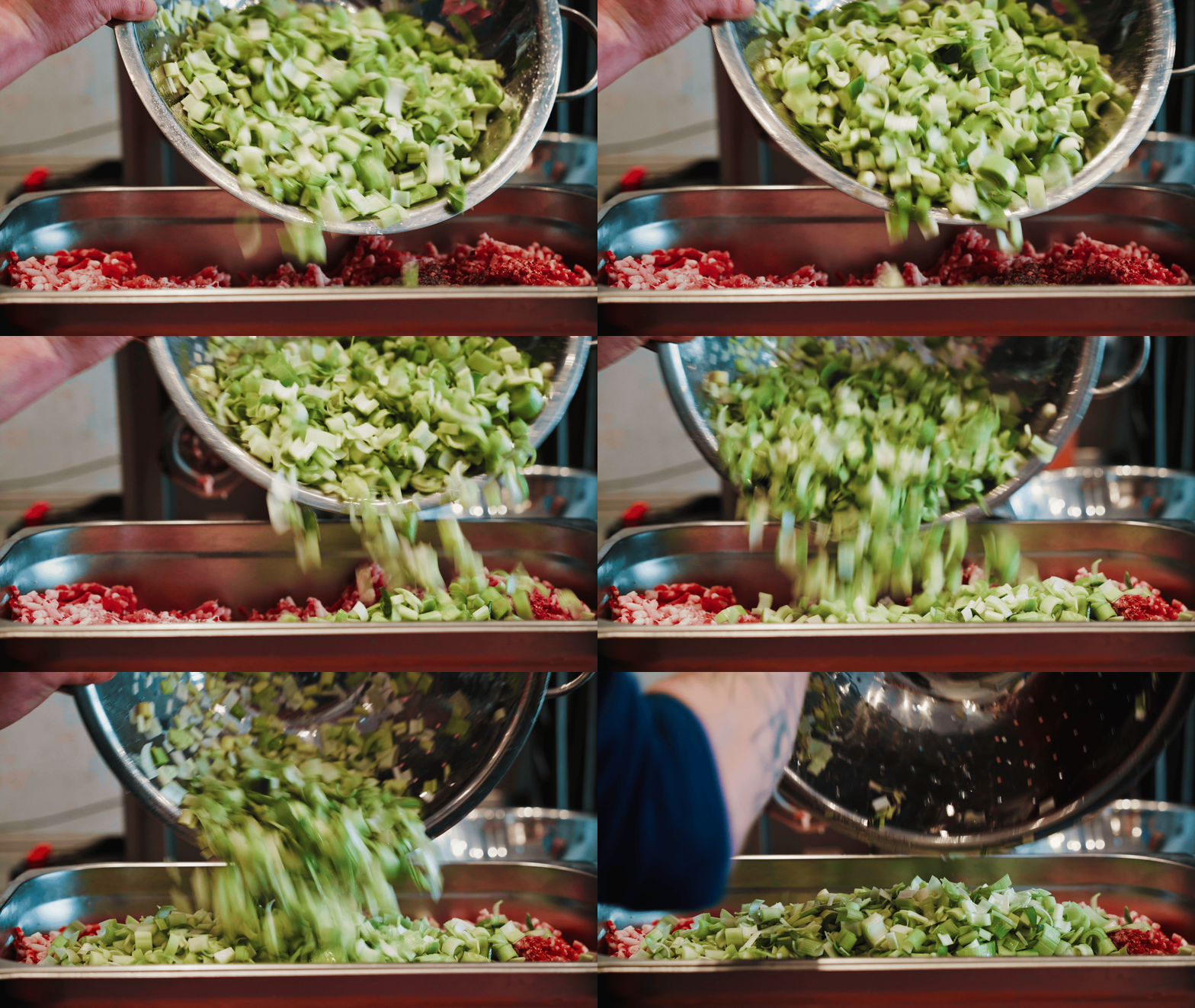
I think the first ever wild sausage that I made was a chili and marshmallow. People said, you can't put marshmallows in a sausage and I said I'm going to do it. Turns out it works really well, and everyone loved it. I thought if that can work, then I can just have some fun. When I’m doing butchery it’s all this ruling and weighing. But when I’m making sausages I can get creative, like the macaroni and cheese. We put marmite and cheddar in there. I think it’s great fun for Harvey as well. It's something that sets you apart from other people. We've probably made over 150 different types of sausage here.
Perry continues to count some of the flavors he has developed along the way, each and every one of them more mouthwatering than the other. I get curious and ask about working with restaurants. He says that for some chefs, it feels too experimental. While they have done some wholesale before, collaborating with chefs is much harder because they do not know what to expect. Getting more involved with restaurants is part of his future plans.
Why is educating others, especially people who are not cooks or part of the industry, important to you?
What I wanted to do was create an environment where people could see the start of the finish, what we're actually using, and it's not all just rubbish from inside the pork. It's actually good quality meat with good ingredients. Also, to just have some fun and leave people with something they can take home. We had people say I'm going to get a little sausage machine for my home. You could buy some herbs, put some spices in it, pump it, link it, and then you've got a supply of sausages. You can't do that with a steak, but this is where the fun happens.
How do people react to the start to finish process? Because you do get a huge part of the animal and you work your way through that, and the end product ends up being something so clean and pristine?
I think it's most important to see the whole animal as it is and go through the whole breakdown. You can see all the different muscles inside and what you're actually using. The amazement on people's faces is incredible because they're just thinking this is where my bacon comes from, this is how you make ham. They've never seen a side of pork being butchered.
What about your relationship with animals changing from when you were 17 to where you are now?
When I was 17 at the meat market, I just thought, meat comes in, meat goes out. I didn't really have much of a relationship with it at all. As I progressed, I started to respect and learn about it a bit more and understand all the different aspects of what the different cuts were, before they were just names on a box. Now it’s the carcass and seeing the difference of good quality, high welfare. It's been an amazing journey to visit farms, to see the husbandry of cattle and pigs being raised and it's really important that people understand that as well.
We share a common grievance, which is that people are just used to seeing the end product wrapped in plastic at the grocery store. They don't necessarily think of how big an animal, a cow or a pig, is because they don’t see it as whole. They just see 200 grams wrapped in plastic. Now, within Big Meat, there's so much happening on the alternative meat side. Especially with lab grown meats, because people's consumption levels are becoming a concern. I ask Perry what his personal thoughts are on how that has affected his business.
He thinks that during COVID, similar to bread making, butchery was partially revived. He’s not worried about plant based meat being consumed more than livestock meat. Most consumers are not aware that the plant based meat companies are owned by the same companies, which funnel that money back into animal-based meat production. Like the pharmaceutical industry, Big Meat has the world on a chokehold.
It is interesting to see the difference in trends between the United States and the United Kingdom when it comes to food trends. Perry and I briefly talk about what he thinks about the protein craze online, and I ask if social media trends affect his business in some way. He shares this one particular moment when they had quite a big week of sales for legs of lamb and nothing else would really sell. His customers told him that Waitrose’s recipe book and social media were pushing out all these leg of lamb recipes. He’s considered subscribing to be in on the trends because people want to try making their own at home. The internet can really make or break your business.
We dust off the stools we have been sitting on to put them away, but I’m curious about Perry’s five year plan. “We've definitely discussed options of where we could go, what we could do. This is where we are right now. In five years though, hopefully a butcher's with a restaurant,” he responds with a smile on his face, “I like cooking for people, you know?”
At that moment, we realize that Perry’s delivery guy never arrived. Perry says “Stu is in absolutely no rush”. Ten minutes later, he gets a call to come outside and grab his fresh carcasses. When Stu arrives, the puzzle pieces fit together. While the butchers carry a whole lamb and a pig on their backs, Stu demands that I pet his dog, a Bull Terrier sitting in the front passenger seat. She’s oddly calm for a dog in a truck full of meat, but Stu affirms me that she wouldn’t be disturbed. He says that she used to be on a protein-heavy diet, but then her skin started getting patchy everywhere. Now, she only eats a vegetarian diet. I ask him what her name is and he replies, “Luna, short for lunatic!” — the cherry on top. Stu gets in the car, and he and Luna go about their way. I head back to the shop. It is now past lunch rush and customers are buzzing into Perry’s.