All About Politics and Spice
Breaking it Down with Chef Eric Huang of Pecking House
By Ebru Eltemur
Photography by Mert Karakas
Since 2020, New York has become a mecca of luxury fried chicken. After the immediate success of The Coop at Double Chicken Please, Korean restaurateur Simon Kim followed suit with his project, Coqodaq. Swarms of tourists and city residents alike are attracted to its extravagant dining room, “healthier” McDonalds-inspired nuggets and luxurious accoutrements such as truffles, fish roe, and an extensive champagne list. His offshoot kiosk at the US Open serves a 6 piece nugget box with a small tin of caviar, drawing in hundreds of customers each year.
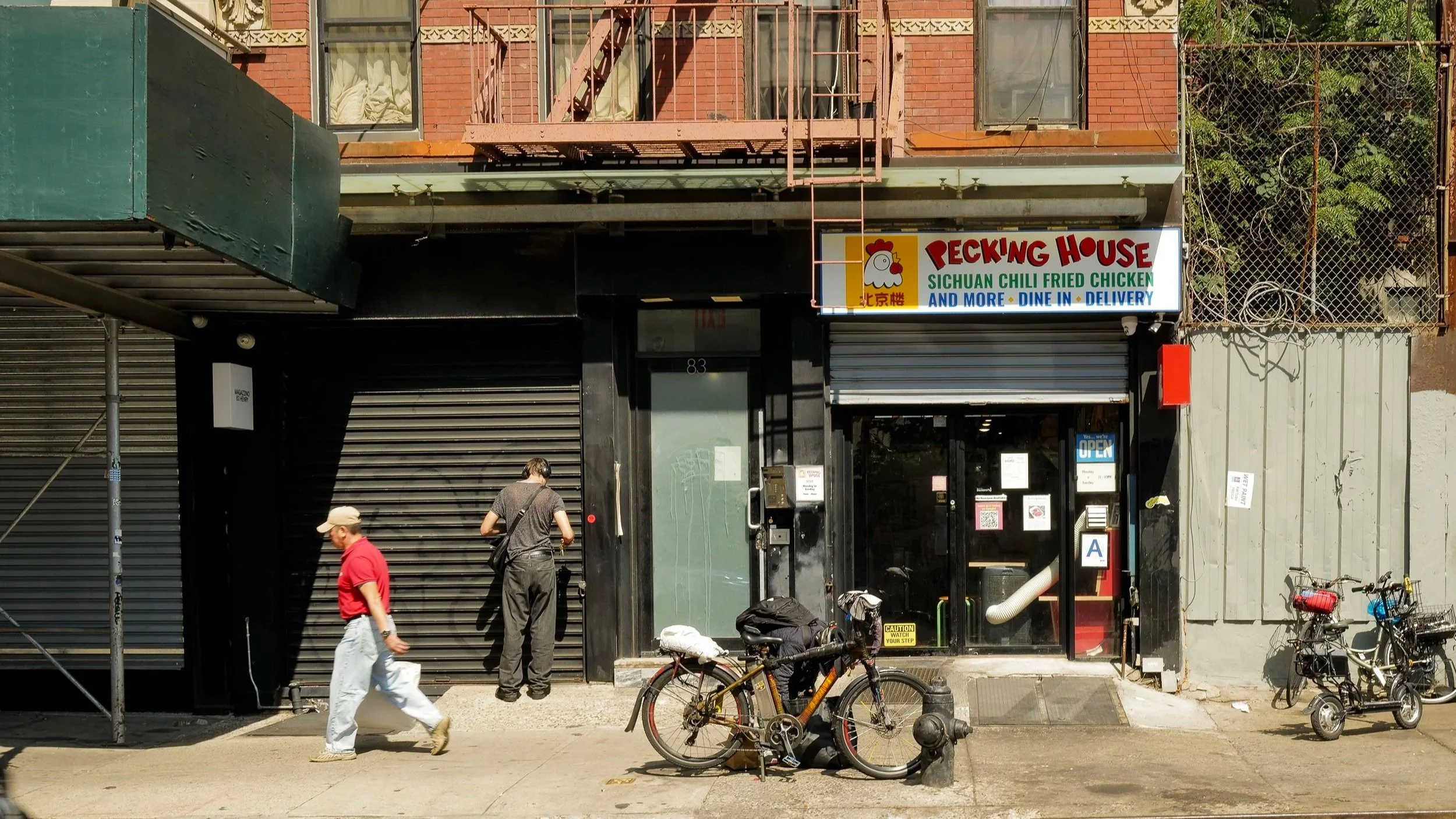
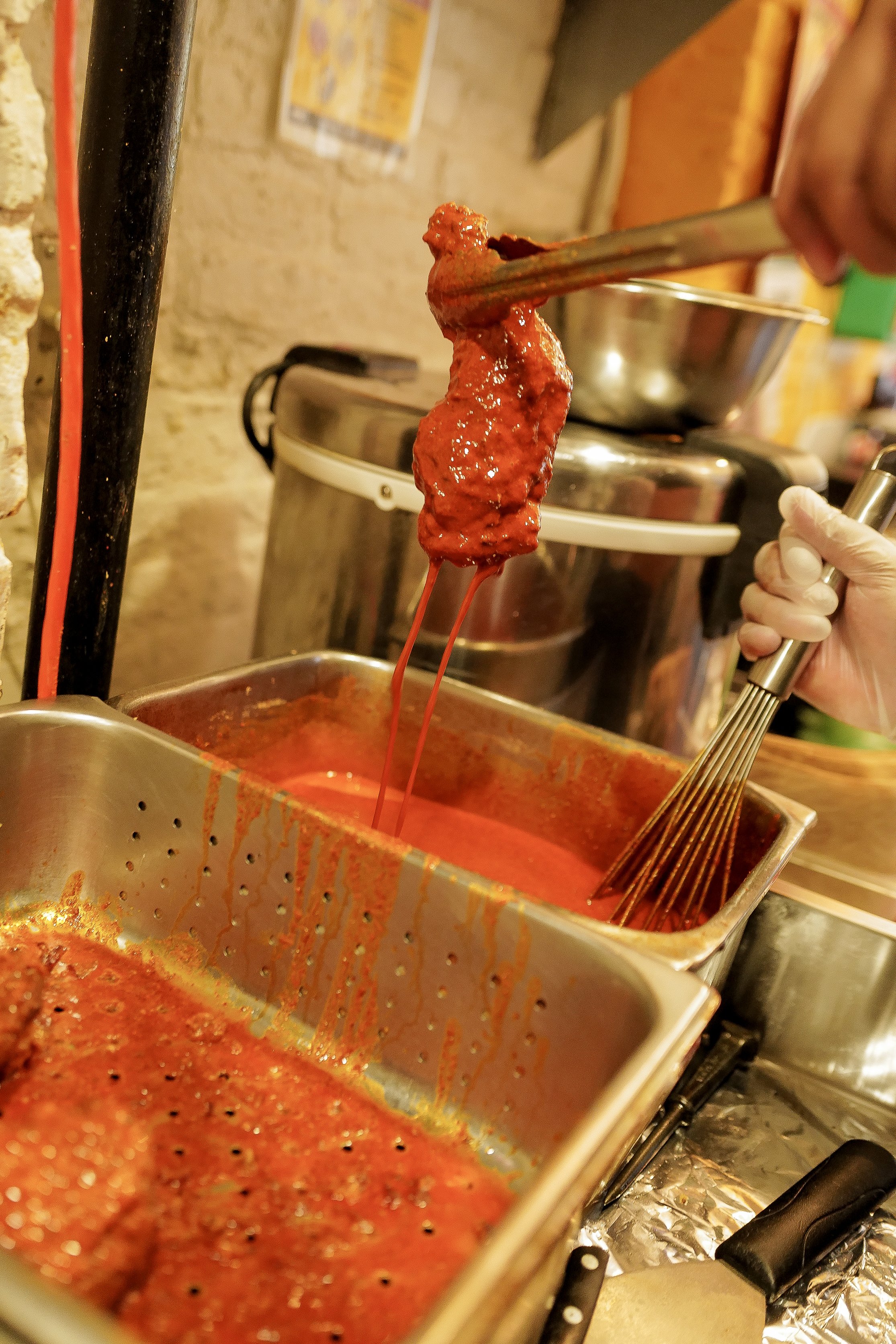
Against this wave of selling comfort as luxury, one shop takes pride in staying true to the essence of fried chicken, the fast food that most Americans associate with comfort, fun and affordability. Because of its humility, or maybe simply because it’s one of the best fried chickens you will ever have in your life, Eric Huang’s Pecking House has become a staple of Chinatown.
Pecking House’s journey was not without hardship. It was born during the Covid-19 pandemic, one of the most socially unstable periods the world collectively experienced in the 21st century. But that room for leeway, that quality of adaptability, allowed the place to evolve into its most current form.
Aside from building a brick and mortar, Huang has also built a steady following on social media. Within the hospitality circles of New York City, he has become known for his sharp and honest political views, and crystal-clear insights into the shortcomings of the restaurant industry.
Shortly after his return from the ROOST International Chicken Gastronomy Festival in London, we sat down with Eric to discuss the origins of Pecking House, and the challenges he faces as a second-generation immigrant business owner in Trump’s America.
You navigated the early side of your career as a second generation Asian immigrant in the fine dining world, notably Eleven Madison Park. Did you ever feel like it broke or rebuilt parts of your personality?
I think if anything, it kind of reinforced it. It did not really break and reassemble anything, but much to my detriment, because I wouldn't allow it to. Having grown up here, I always felt a bit of otherness. I spent most of my life in very Italian and Jewish-dominated neighborhoods. We were often the only Chinese and the only Asian family. I was often the only Chinese person in school, which is kind of crazy to think about. That being said, I was always aware of it. EMP was no different. I was the only sous chef of color, often one of the few people of color there. I infamously made a joke when I got promoted, saying “Thank you for letting me be a diversity hire here,” which obviously wasn’t appreciated humor. It took a while to process it and understand it. I didn't belong and I was just getting in trouble for speaking up a lot of the time. At the time I didn't really understand it, but now I do, that sort of criticism and sort of self-awareness was not welcome there. It still isn’t in a lot of places, especially places of “prestige”. I had a hard time getting promoted and moving along the promotion track because of my intentions of challenging the system.
And you frequently call Pecking House a happy accident.
We call it an unplanned pregnancy these days.
A very happy one for customers. During the early months of the pandemic, when you started the business, there was a lot of vitriol, particularly against Chinese American communities. Did that cause any anxiety about its success?
I was not worried about the pop-up, even though we were experiencing a lot of anti-Asian sentiment in America. Where we are right now, Chinatown, looks completely different than it did before the pandemic. At the time, I did a lot of work with Patrick Mock. He was doing a really wonderful initiative of cooking and delivering meals to people in need. It was really hard to see all these longtime generational businesses that were shutting down. There was my own family's business. My mother’s restaurant was empty all of a sudden.
—
Eric explains that his mother’s restaurant was in a particularly difficult situation, as it’s located in Nassau County, a heavily red-voting area. He credits the President for the anti-Chinese sentiment that became rampant during the pandemic, sharing how he got into trouble with customers at times. His mother, a first-generation immigrant, felt that playing along would be better to survive this period and avoid conflict. She had to repeatedly reiterate that she was an American citizen, and that she employed American citizens.
—
For me, as the second generation that grew up here wanting to challenge that system, I felt it was all this bullshit. Anyway, with the lockdown, everybody wanted Chinese food, so our popup was busier than ever. There was plenty of demand so I wasn’t necessarily worried about its success.
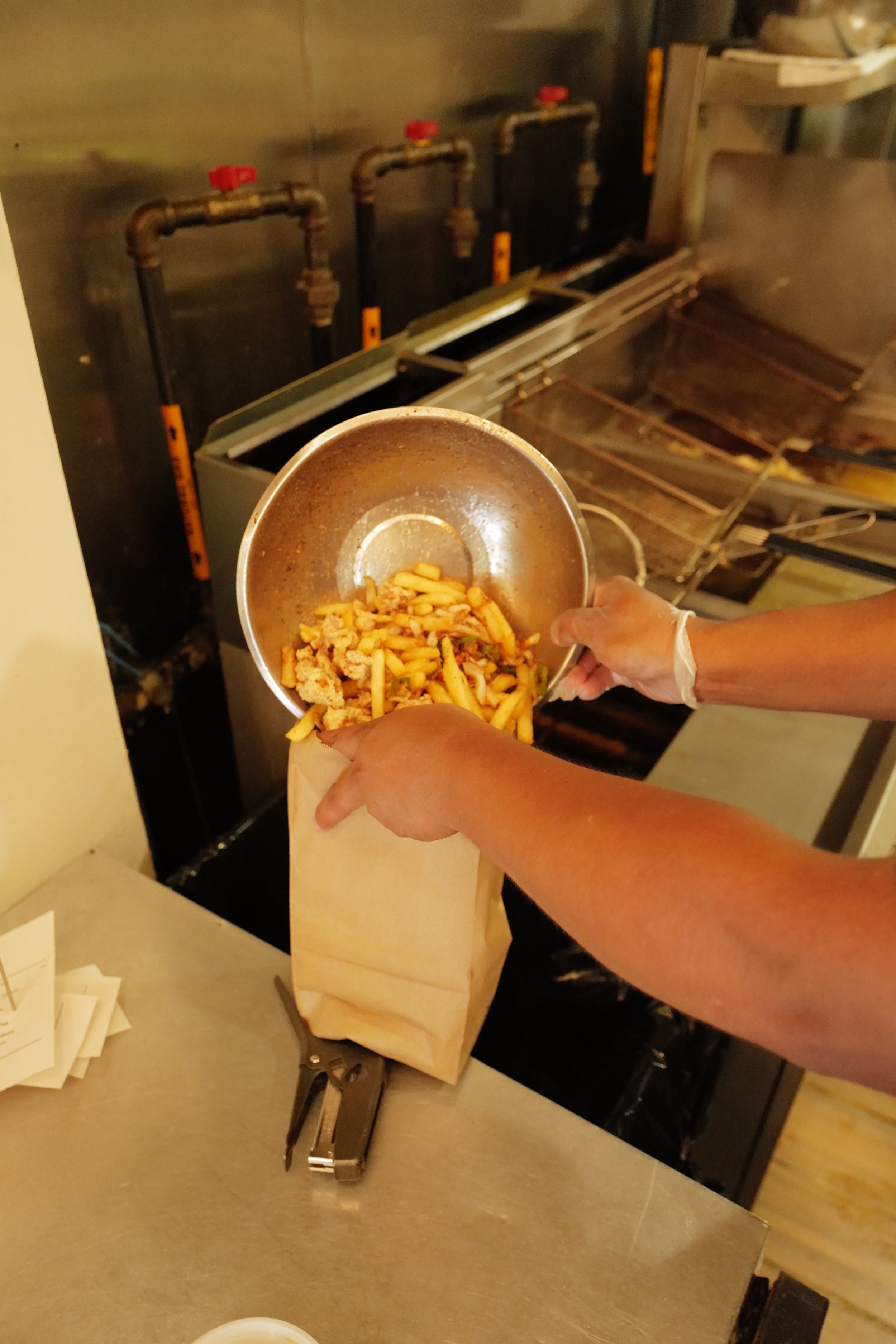
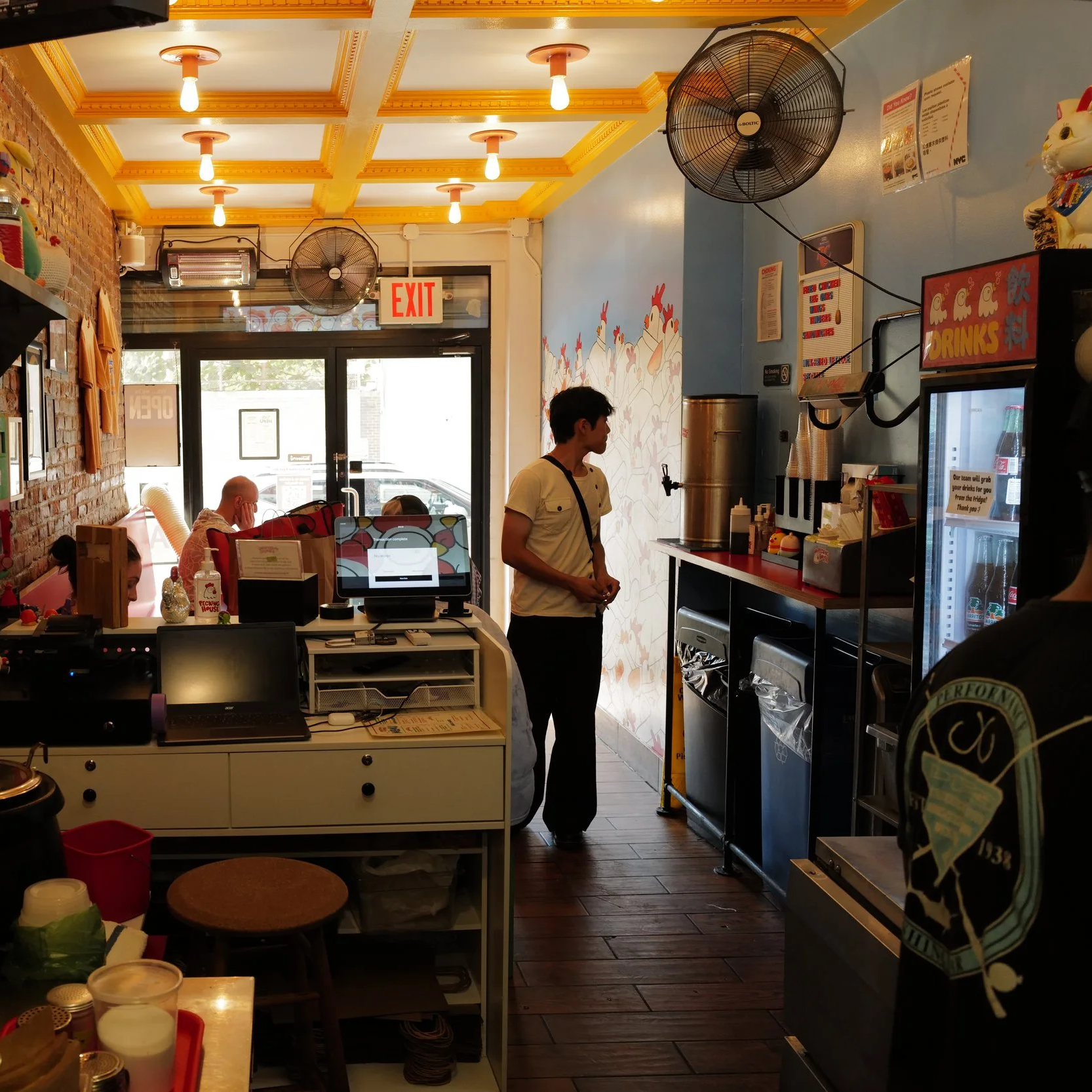
And then fast forward, you open the Brooklyn shop. As you explain in your own writing, because of certain conditions, decisions and whatnot, Brooklyn doesn't work out and you open the Chinatown spot. What has being in this neighborhood meant to you? How does it play a role in your decision making now?
As per usual with the way I run my business, it's a bit of an accident and I didn't really put nearly as much thought into it as I should have. I simultaneously overthink things and under-think other really big things. So I definitely underbaked this idea, but I got lucky and it worked out. If I was presented with my current level of judgment and decision making, I probably wouldn't sign this location again, but I'm thankful it worked out. Not because of anything against Chinatown, it's literally just the placement (of being under train tracks). There's a lot of second generation operators who are coming back to the neighborhood, but this model for us is great, this tiny little restaurant.
I was maybe a little too proud while opening Brooklyn. I thought it would suck to go through the pandemic and just open the same kind of restaurant with the same kind of business model and practices that we were doing before. I really wanted to break the model, to try to exist in this place between being a sit down restaurant and a casual counter. In a lot of ways, there was merit to that, but unfortunately, I don't think the public was really ready for it.
People are more ready for that now because of the way the economy has also changed. The spending power has changed.
People exiting the pandemic just wanted to rush back to familiar patterns and familiar restaurants. We wanted to dine out again in the way we did before. There was a resurgence in luxury and fine dining. It bifurcated the economy in a lot of ways because the only way to survive that period was by either being an ultra cheap national brand or an ultra expensive luxury experience. Everything in the middle was really, really hard. It still continues to be very difficult, but people are recalibrating a little bit. Now, I'm changing how I approach the restaurant and what I want out of it, but it's been really good for me. Understanding how to build a healthier relationship with my own restaurant – not living here and cooking, and watching every piece of chicken you make, just accepting it for what it is. There's many times when I want to give up on it and sell it, close it, whatever, be done with it. It's been 6 years since the first time I cooked at Pecking House. My wife and I finally decided that we would really regret giving up on this, looking back 10 years from now, even though right now it feels like what we want to do. It deserves our full heart and attention at least one more time, so we're gonna give it one more go of expanding and seeing what its future is. I don't think it ever will become this giant, nationally scaled private equity business because that’s just morally bankrupt in many ways.
—
Our conversation is interrupted by more people flowing in. This time, Eric speaks Spanish with his customer and employee. He speaks three languages at a restaurant capacity; English, Spanish and Chinese. He grades himself as a B plus in Chinese and Spanish in the restaurant, and a very solid C minus anywhere else. This inherent multiculturalism seeps into the menu too. Eric’s twists on fried chicken draw inspiration from around the world, using blackened thighs with a salsa macha in a milk bread sandwich or tossing tenders in a classic Irish-Chinese spice bag in another.
—
How are you managing being a business owner in this political climate?
It’s been horrifying. It's been terrible. I remember especially there were two immigration raids where people were saying they came to Chinatown. Obviously in (Trump’s) America, Central and Latin and South America have been so destabilized by imperialism for this exact reason to cause desperation among those people, and that's why they take these immense risks of coming over to the United States. I've been working with immigrants ever since I was a baby, at my mother’s restaurant, and there are people who are still there. These people, and the volatility and difficulty of their lives have been deeply ingrained into my childhood experiences. When we opened Brooklyn Pecking House, there was a huge influx of immigrants from Venezuela due to the economic crisis there. I had never really worked with that many Venezuelan immigrants. I came to learn their struggle and understand what it was like to walk over the Darién gap with their children strapped to their backs to come here. I would hear stories from employees who went to school for photography in Venezuela, but they’re frying chicken with me because they don't know what else to do. For their asylum applications, they’re standing in line for hours and hours a day, trying to get it sorted out. There’s also tension with other immigrants who came from Guatemala and Mexico who didn't get assistance from the city, and they're understandably very bitter about it. The system has failed them in so many ways.
It turns people against each other because of how unfair it is.
Exactly, because everyone is in desperation to survive. With the ICE raids, I remember training my employees how to deal with this situation, constantly being anxious about it, watching my phone for messages at any moment. Seeing them on Canal Street, busting up all the handbag markets and arresting people, pinning people to the ground just felt ridiculous. It’s happened to someone who has worked for me. Whenever I don't hear from people, whenever there's no call, I worry about something happening with their family. It's all tied to this for-profit prison complex kind of industry, a version of modern slavery. I just don't understand how people still can make the other argument. You’re a Bible-thumping Christian but you’re voting for this... I just don't understand it. I don't think I ever will. But I do my best to navigate the situation.
You’re one of the few restaurants in the city where people get tipped out, whether they're at the register or in the kitchen. How does that challenge you as the business owner?
I would first personally tell you that I acknowledge that it is a liability. The 80/20 law does exist with good intentions. It's because there are unscrupulous business owners who were abusing that. They would think they have this tip-credited employee, so they can make them clean the dry storage for $4 an hour, which is again speaking to how stupid the whole tip system is in general. Anytime I travel outside of the United States, I realize how much better it is elsewhere. I could write a whole thesis on why I hate this and why it exists. What I've had to do is build an entirely new business model where everybody does the same thing, everybody works the register and the kitchen. We don't have a traditional pronounced model of counter-service. People reach out to me all the time, asking how they can create this model in their restaurant. Unfortunately, you are probably not going to be able to do this because the way every restaurant is structured, it just doesn't work. It's not to blame on anyone. A server who is responsible for a guest experience does have the grounds for being entitled to the gratuities from those experiences. So it’s very much about stripping down the business model and making it this very low touch customer service, counter service model. It's the only way I could do it.
I cannot rely on people leaving tips here, everyone has to at least make minimum wage. Obviously we pay better than that. We try to pay it well above market rate plus tips. Most of them are making $22-$23 an hour. I just have faith that if I treat my employees well, they're not going to file a punitive lawsuit for what would be pennies. I'm confident saying that out loud. I wish I could eliminate the entire thing entirely, but frankly, if I were to eliminate this, I would have to charge $19 a sandwich, and then people wouldn't understand why. And frankly, that's been proven many times over and over that the American consumer is not ready to understand why tipping subsidizes all the costs of their life. They love getting on the internet and saying business owners should just pay everyone fairly. We’d love to, but your behavior does not allow it. So I would always say if I ever had the chance to be on Subway takes, this would be my hot take.
—
Naturally, our conversation segues into the “chicken-gate” of Brooklyn from a couple of months ago. One of Eric’s favorite jokes is that Americans should have to spend a minimum of 2 years in the industry as national service, because it’s bound to make you a better person. A very small amount of people truly know about restaurant operations, even though everyone participates in this system one way or another. He cites his Substack letter “How to Eat Chicken in a Neoliberal Nightmare”, explaining that $40 for a half a chicken is high, but justifiable. “It’s more of a reflection of where we are at with our systems, rather than the money-grab it was perceived to be.”
—
Protein in general in America has been so artificially subsidized by the government and economies of scale based on corporations. The way we treat animals is horrific. I would change so much about it, but we're talking multi-multi-billion dollar industries. So people are very accustomed to ultra cheap chicken and protein, like dollar burgers. Thinking about a place like Shake Shack, let's say, which is still very expensive for what it is. If Shake Shack existed in only 2 places and it was an operation like this, it is justifiable, but it's not when you're Danny Meyer. We know where you're funneling the money to. It's really strange to me because this was something close to my heart that really frustrated me. Things were really good in Brooklyn for our first year because people would order directly from their website, cutting out the delivery app. Then as we went back to our old patterns, people became addicted to delivery apps. They cannot break the convenience of it. I want people to think about how many people you need to pay. You pay the supplier, the restaurant, the person who made the food, and then the shareholder value, and then the delivery person. So there's a reason why it comes up to that price. I wish people could examine what they're trading for convenience. It's an expensive luxury that we all really got used to.
Earlier in our conversation, you had shared that your mom’s dedication to her business was something you witnessed from the day we were born. For a lot of immigrants, the restaurant industry usually appears as the only way to make money upon arrival in America. But your mom was able to find more purpose and passion. How do you think some of that has come through to you looking back?
Now, the wonderful thing about my mother is that she's incredibly dedicated. She's incredibly tough and hard-working. The problematic things about the way my mother works is the amount of anxiety she dumps into it and her toxic codependency with the restaurant. She's worked 7 days a week for 50 years because she cannot detach her identity from the restaurant. That's a very powerful thing in a time of crisis when you need to buckle down and do your thing. But as she gets older, now approaching 80, she needs to step away. It is very difficult because she's now preparing for a very different phase of her life where she needs to pay attention to herself and her family more. What I'm learning from her now is that – while I'm very grateful for the amount of dedication she has shown and how tough she has been, all she has done for me, including helping me save this business and bailing me out many times – I do not want to repeat that. I don't want to raise my kids in a restaurant. I want them to have a childhood and I want to be present for it. I completely understand and forgive, and have compassion for why my mother did what she did, but I want to try to improve on that because there was a lot of hardship for me and my sister growing up in a restaurant, and not having anyone there for us.
Do you think that her dedication and the speed at which she was working, played a role in you choosing fine dining initially? Or was that more your decision?
I mean, the Asian American childhood is very much like that right? You have to go to Harvard, and this is kind of our version of that. If you are going to be a chef, we need to be the best at it. She still harps on that to this day, telling me I should get back into fine dining. I think there's this innate understanding of the dynamic between obsession and work ethic. Where's the line? When I went to culinary school, there were all these people like Anthony Bourdain and Bobby Flay who were making this profession very romantic. Most people wanted to join the restaurant industry without being prepared for the reality of what it really looks like. And from day one, I knew what that looked like. I think I was well prepared for that reality.
How was the book writing process? Were there any memoirs you personally looked up to in the process?
I get really frustrated by chef memoirs. Because if there isn't an actual writer or a ghostwriter, they're just so whitewashed. Frankly, it's because Michelin gives these chefs a platform, makes them famous and they don't really know what to do with it. What is really frustrating to me about what I call the “Michelin Industrial Complex” is, I get it. There are millions of dollars at stake here, entire careers and restaurants. I understand the desire for self preservation, but it just sucks. Anything anyone talks about in the industry is so whitewashed because they're afraid of offending the machine. Pecking House is a blessing in that regard because it finally removed me from that system and allowed me to realize how broken it is.
During the time when the abuse allegations against Rene Redzepi started coming out this year, you were quite vocal on Instagram. You made a post about the brigade system and how it mentally abuses people, while so many were justifying that behavior as a price tag for merit. Do you think your outspokenness on these issues has gotten you into trouble in your career?
Truly no one really talks about these things. I'm sure there have been plenty of people who have unfollowed me, but I'm pretty exhaustive about exploring my points. I think it’s unfortunate that some people are so narrow-minded about what is possible in the industry, wanting everything to remain fixed in their ways. Speaking out at that time just brought me more into the reality of what the consequences of publishing a book that is as honest as mine will be. Deep inside I knew that, but that was the first time I really felt it, because I had old colleagues from EMP who were not happy with how outspoken I was being. They were very concerned about what I was going to say. From my perspective, I'm just always going to tell the truth. From their perspective, which I get, they want to protect their livelihoods, their reputations, and what they see as this thing that they invested their whole lives in. They want to protect that, and I can understand that. It’s unfortunate because it leads to a reckoning with our inherent yet unbridgeable gap, between our values and understanding of life. If you do not inherently agree on those values, you can’t really be friends with those people that want to protect a broken system, at least not in a meaningful way.
To directly quote some of your writing, you said in a post about your time at EMP, comparing yourself to beaten leather, “There is utility and resilience to my existence despite the fractured optics”. How did that understanding of utility and resilience change as you transitioned from a career dedicated to fine dining to owning a business like Pecking House?
This is a really deep question, but it was an absolutely brutal transition. I make these analogies a lot and I think a lot of people misconstrued it as I'm trying to lionize myself. It is not at all that. I talk about lionization of the fine dining industry and compare it to the military, not as a compliment. It's the exact same mechanism. You take these disenfranchised young men, who usually have no idea what they're doing with their life, and feel lost, and they crave purpose, structure, and direction. That was the case for me. It was the same for the men I worked with. That’s a greater conversation about masculinity, and in general, how problematic it can be. These sort of institutions prey on and function on that. They take these young men and choose to indoctrinate them. It's very hard to separate your identity, to find out any form of who you are as a person, because it requires that you give your entire self to it. But then the process later in life of separating yourself from that is awful. That was the case with Pecking House and it's still a challenge to this day. I am not this restaurant, although I am very personally tied to it. I can't even tell you how many years it took me to stop reading Google reviews and feeling like I got stabbed in the heart. I kept feeling like I had to read them and process them, and creating that boundary took forever. Not to mention the years of substance problems as well to get through to the other side. There's a lot of mental health crises in our industry in general. Pecking House never would have happened without the name of EMP being attached to my career and I acknowledge that. But that doesn't mean you can't criticize the system. It also doesn’t mean that we should keep repeating it over and over again. If that’s how it worked, we wouldn’t be able to criticize any of the systems that we exist in. Do we really want to perpetuate those things? I would argue, no.
And despite all of these things, you really seem to know how to take this industry with a grain of salt and humor. How does humor come into the way you cook?
That's why I like jokingly calling it an accidental pregnancy. In a lot of ways, Pecking House is incredibly representative of who I am. Growing up eating American and Chinese food, it all kind of came together and created this indecent lovechild of said union. When you are in fine dining for so long, you are surrounded by all these typically tall, white, athletic white men who just take themselves so seriously. You just want to say, “Calm down.” At the end of the day, I'm not saying that we can't take our craft seriously, I want to take my craft seriously. I want to make an excellent product. I want to be a great technician and a great operator. But at the end of the day, we are making food. It’s important to always keep that reality, we’re not saving lives over here. It's just narcissistic. Try to embrace the duality where you do it. There can be nobility and importance in what you're doing, but at the end of the day, what is really the mission of what you're trying to do? It's self-serving, you know? So maintain it, but be humorous about it, for the love of God, please.